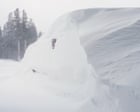
According to experts, several weeks of alarming snow drought in the western US is due to the climate crisis and helped set the stage for this week’s deadly snowfall in Northern California’s Sierra Nevada mountains.
Dangerous avalanches are not uncommon in the region, according to the National Avalanche Center, which maintains a map of places with high avalanche danger, and the Lake Tahoe area is now at high risk.
Tuesday’s avalanche has so far killed eight backcountry skiers, making it one of the deadliest in US history. One skier, still missing, rescued six who had been stranded for some time. The avalanche is now the deadliest single event in the US in 45 years.
The avalanche danger became more serious after several feet of new snow had fallen since Sunday, leaving the ski group to begin its trek, settling on top of the previously hardened layer, making it unstable and easily triggered.
According to Craig Clements, a meteorology professor at San Jose State University in Northern California, the new snow doesn’t have time to bond with the previous layer before the snowfall subsides.
When the weather is dry and clear, as it has been in the Sierra Nevada since January, the ice crystals change and may become angular or rounded over time, Clements said. Heavy new snow is different and does not bond to the snowpack, forming a so-called “storm slab” on top of a weaker snow layer.
“Because it’s on a mountain, it can slide because of any change in tension up or down, sometimes naturally, but also because of people traveling through the area,” Clements said.
Officials did not say what caused Tuesday’s snowfall.
If there’s more consistent snowfall throughout the winter, the different layers can bond more easily, Clements said. But even if a slab of ice does form, the danger often lasts only a couple of days until the new ice stabilizes, he said.
A climate crisis can lead to climate extremes that include both drought and heavy precipitation. Clements said he did not believe this individual snowfall was directly linked to the climate crisis and that it was a “climate phenomenon, not a climate phenomenon”.
However, the West has seen record amounts of snow this season, despite how warm the region is, which many scientists say is linked to the climate crisis from burning coal, oil and natural gas.
Since Dec. 1, more than 8,500 daily high temperature records have been broken or tied in the US West, according to National Oceanic and Atmospheric Administration (NOAA) data.
Daniel Swain, a meteorologist at the University of California’s Water Resources Institute, said that most of the precipitation that usually falls as snow in the mountains for months is falling as rain, which is coming more quickly.
This is the problem that scientists have warned about with the climate crisis.
“It’s been very warm, especially in December, only snowing high in the mountains. Then we go into January and it’s been very dry and warm almost everywhere for the last three to four weeks,” said Daniel McEvoy, a researcher with the Western Regional Weather Center.
The Associated Press contributed to the reporting