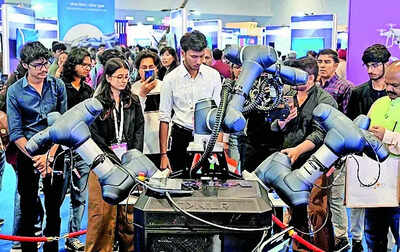
Visitors will explore cutting-edge artificial intelligence tools at the summit on Wednesday
NEW DELHI: The current leading models of artificial intelligence are being developed by a few companies in countries like the US and China, while most other countries are “passive victims of the things they have built,” said Yoshua Bengio, a professor of computer science at the University of Montreal, at the AI Impact Summit in New Delhi on Wednesday. Bengio, who is widely considered a pioneer in the field of artificial intelligence, stressed that only a small number of countries are leading in this field is “unacceptable” and said that countries must address this matter at the highest diplomatic level. Frontier models in AI are the most advanced and large-scale general-purpose machine learning models that are currently pushing the boundaries of power, multimedia (text, image, audio, video) and performance. It is not just about ethics, but also about sovereignty, Joshua said.
He added that this is also related to the concentration of power. “If AI capabilities continue to grow, there is a real possibility that there will be a significant discrepancy, even more than there is now, between models, for example, in the United States and China and models that are being developed in other countries. This could give those two countries or whoever is leading tremendous economic power.”
..”, noting that “…the stability, the geopolitical stability that we have known since World War II could flare up.
“I’m not saying that’s going to happen, but when you give that much power and when you concentrate it that way, there’s a real risk that you’re going to bring the house down.” These observations gain great importance at a time when India is leading a drive to democratize artificial intelligence. Regarding what India should be careful of with regard to AI, Bengio said people should keep in mind the impacts or risks being taken that will impact society while developing technologies.
“We need to understand it scientifically. We need to understand it socially because there is a social-psychological component in the case of artificial intelligence because we are talking about systems that interact with people and language.
Hence, a country like India can contribute to this understanding.” He also said that there is an urgent need for an independent risk assessment before deploying open AI models. “If the risks are not too great compared to the benefits, because obviously there are benefits to sharing, especially in developing countries like here in India, then certainly you should be completely open.
But if you see that the risks exceed the threshold of social accessibility, then you should not. “This way we may be able to capture the benefits of open source when it makes sense and we can prevent otherwise disastrous uses,” Bengio said. The professor also compared how a comprehensive risk assessment should be conducted before allowing the sale of medicines, and the same should be followed when using artificial intelligence in public places. “You can’t do what you want, it will make you money,” he said. “You first have to prove to an independent party, such as government representation, that your product will not be harmful. But there is no such thing at the moment. It is a scandal.”