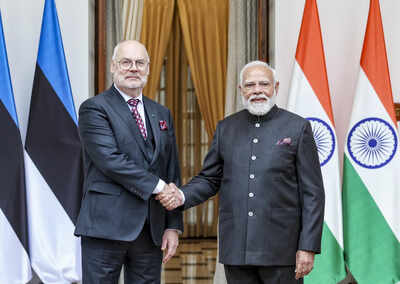
In this photo taken on February 18, 2026, Prime Minister Narendra Modi with Estonia’s President Alar Kares during a meeting in New Delhi. (PMO via PTI Photo)
Estonia is widely using AI in education and would like to collaborate with India. In an interview with TOI’s Surojit Gupta, Estonia’s President Alar Kares spoke about how to build trust while delivering citizen-centric e-services.
Excerpts:What can Estonia offer the world and India in terms of AI and technology? We can offer India and the rest of the world our experience and how we have digitized our society. One of the important things we have to share with the rest of the world is how to build trust as we move toward digitalization or use of artificial intelligence. You must build trust not only between technologies, but also between governments and societies as a whole. Artificial intelligence is still developing very rapidly. We don’t know what’s going to happen, let’s say after three months or even two weeks. But we are ready and trying to use this new technology intelligently.
This is what we can say to India. India is also a digital country, so we learn from each other. Can you give us a glimpse into the digital transformation that has taken place in Estonia?In Estonia, everything is online. This means that you can even get married online. You mentioned taxes, you mentioned prescriptions, basically everything. One startup, instead of hiring lawyers, is using artificial intelligence. This does not mean that we no longer need lawyers, but we can focus on the more important things as there are queues in Estonia to get to court.
How can you ensure data privacy?Privacy is becoming more important with AI technology. Data may be owned by citizens, but data privacy, especially medical care, is a concern. We see in Europe, and in some countries, how difficult it is to provide ID cards because people are concerned about the data. What is the increase in productivity as a result of digital transformation?Someone calculated that it raised GDP by 5%. These are calculations that are just made by administrators. It makes your life very convenient. In some countries, it is very difficult to fill out tax forms.
For us, it’s pre-filled. It may take a few minutes if you don’t have anything to add. It makes the whole thing transparent. To get prescriptions, you don’t have to go to the doctor. He knows what your ailments are and gives you a prescription, which you see immediately and go to the pharmacy. What areas of cooperation do you see with India?Like India, Estonia values education. We can cooperate on this matter. We started AI Leap. We have been providing access to computers in schools for 30 years. Now, we’re doing the same thing with artificial intelligence. We teach teachers and students how to use AI intelligently. We collaborated with OpenAI and Google and asked them to provide a platform that suits the needs of students in Estonia. AI Leap is in every school and we are learning how to use it and how to change the entire system of how students are taught. What are your views on regulation of AI?Regulations are needed. We’re trying to make sure there are global regulations, at least at some level. But every country is different. There are limits to technology and there are rules and regulations.