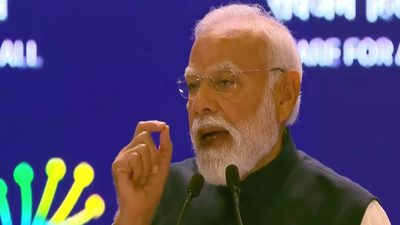
New Delhi: Prime Minister Narendra Modi on Thursday hailed India’s growth in artificial intelligence as he joined world leaders, heads of state and global technology leaders at the AI Impact Summit.While delivering his keynote address, PM Modi said that AI needs to be democratized to ensure that humans do not become a data point or raw material.
‘A very positive case study’: Meta AI President Alexander Wang lauds India’s AI startup ecosystem
Below are the most important quotes from Prime Minister Modi’s speech
- We have witnessed the destruction of nuclear energy and its positive contribution as well. Likewise, AI is also a transformative force. If it deviates from the direction, it results in a defect, and if it goes in the right direction, it results in a solution. “How to make AI human-centric rather than machine-centric, how to make it sensitive and accountable – that is the main purpose of this Global AI Impact Summit.”
- India sees a strong future in the field of artificial intelligence. We have talent, energy and political clarity. I am happy to inform you all that at this summit, three Indian companies launched their AI models and applications. These models show the talents of our youth. I invite you all to design and develop in India and bring it to the world and humanity.
- We are entering an era in which humans and intelligent systems co-create, co-work and co-evolve.
- Decades ago, when the Internet began, no one could have imagined the number of jobs it would create. The same applies to artificial intelligence. Today, it is difficult to imagine what kind of jobs will be created in this field in the future. The future of work in AI is not predetermined. It will depend on our decisions, our path and our course of action. I think the future of work represents a new opportunity for us. This is the era of humans and intelligent systems working together.
- Today at the AI Impact Summit in New Delhi, I’m presenting MANAV’s vision for AI. MANAV means human, and MANAV Vision M – Moral and Ethical Systems says: Artificial intelligence must be based on moral guidance. A- Responsible governance means transparent rules and strong oversight. N- National sovereignty means data of its right. A- Available and comprehensive means, and artificial intelligence should be a multiplier and not a monopoly. V- Valid and Lawful Means AI must be legal and verifiable. MANAV’s vision for India will become an important link to the well-being of humanity in the 21st century AI-driven world.
- We have to be more careful about children’s safety. The AI space should also be child-safe and family-oriented.
- Let us pledge to develop AI as a global common good. Today there is an urgent need to establish global standards. Deepfakes and fabricated content destabilize the open community. In the digital world, content should also carry authenticity tags so that people know what is real and what was created using artificial intelligence. As AI creates more text, images and video, the industry increasingly needs watermarks and clear source standards. Therefore, it is important that this trust is built into the technology from the beginning.
- For AI, humans are just data points. To ensure that humans are not reduced to mere raw materials, artificial intelligence must be democratized. It must become a means of inclusion and empowerment, especially in the Global South. We must give AI open skies and also keep it in our hands, like GPS. GPS shows us the way, but the final decision about which direction to go is ours. The direction we take AI today will determine our future.
- The pace at which the world’s youth are adopting and owning AI is commendable. There is tremendous enthusiasm among young people for the AI Summit.
- Artificial Intelligence is a transformative force. If it is directionless, it becomes disorder; If the correct direction is found, it becomes the solution. How to transform AI from machine-centric to human-centric, and how to make it sensitive and responsive, this is the core goal of the Global AI Impact Summit. The theme of this summit clearly reflects the perspective through which India views artificial intelligence. Everyone’s well-being, everyone’s happiness. This is our standard.
- We must make skills acquisition, upskilling, and lifelong learning a mass movement. The future of work will be inclusive, reliable and human-centric. If we move forward together, artificial intelligence will elevate humanity’s potential.
- We must have a big vision and take an equally big responsibility. Along with the current generation, we also have to worry about what form of artificial intelligence we will hand down to future generations. Therefore, the real question today is not what AI can do in the future. The question is what do we do with artificial intelligence nowadays? Such questions have been posed before humanity before. The most powerful example of this is nuclear energy. We have seen its destruction as well as its positive contribution.
- I welcome you all to the world’s most historic AI Summit. India is the center of the world’s largest technology cluster. It is a matter of pride for the Global South that the AI Summit is being organized in India.
- When signals were first transmitted wirelessly, no one imagined that the entire world would one day be connected in real time. Artificial intelligence is such a transformation in human history. What we see today, and what we expect, is just the beginning of its impact.
- Artificial intelligence makes machines smart, but more than that, it increases human capabilities many times over. There is only one difference: this time the speed is unprecedented and the scale is also unexpected. Earlier, the impact of technology took decades to become visible. Today, the journey from machine learning to learning machines is faster, deeper and broader than ever before.