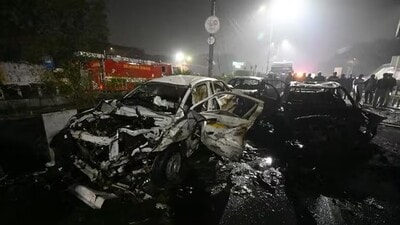
New Delhi: Jaish-e-Mohammed (JeM) has claimed responsibility for several attacks and was linked to a suspected suicide car bombing near New Delhi’s Red Fort last November, nearly a month after JeM chief Masood Azhar announced the creation of a women-only wing of the terror group, according to a new UN Security Council report.
The report said that JEM was “reportedly involved in the attack on the Red Fort in New Delhi on November 9 in which 15 people were killed”. (Sanjeev Verma/HT Photo)The Security Council’s biennial report on sanctions against al-Qaeda and the Islamic State, released this week, said JM was “reportedly involved in an attack on the Red Fort in New Delhi on November 9 that killed 15 people”.
The Sanctions Monitoring Group report noted that UN-designated terrorist Masood Azhar “formally announced the establishment of a women-only wing, Jamaat ul-Muminat (not listed), on October 8 last year, whose mission was to support terrorist attacks”. It also noted that a UN member state said that JeM had “claimed responsibility for a series of attacks”.
Also read: ‘Delhi blast conspirators will be brought to justice’: PM Modi on Bhutan
The report also said that another UN member state reported that the JM had “disappeared”. While the report did not identify individual member states, it appeared to be a reference to Pakistan, whose government has for years claimed that groups such as the Jamaat and Lashkar-e-Taiba (LeT) had “disappeared” after being banned under domestic anti-terrorism laws.
More Read

The report also noted that it was reported on July 28, 2025 that “three persons were killed allegedly in connection with the attack in Pahalgam, Jammu and Kashmir”.
Last April, 26 civilians were killed in a terrorist attack in Pahalgam by LeT proxy The Resistance Front (TRF). India later targeted terrorist infrastructure in Pakistan in May in retaliation for the attack, triggering an intense four-day standoff.
1267 The Sanctions Committee monitors sanctions against al-Qaeda, the Islamic State and their affiliates. In the 1990s, LeT and JEM fell under the committee due to their links with Al-Qaeda.
More Read

Also read: India dismisses Pakistan Army’s Waziristan terror claims as ‘humiliating’
In the section on Afghanistan, the report notes that the “de facto authorities” – a reference to the Taliban regime – continue to provide a permissive environment for “various terrorist groups, particularly the Tehreek-e Taliban Pakistan (TTP)”.
There has been an increase in attacks by the TTP from Afghanistan into Pakistan, resulting in military exchanges and “fragile” regional relations. Although the Islamic State-Khorasan (ISIL-K) has been “under counter-terrorism pressure”, it has maintained a “robust capability, and intent to conduct external operations”, it said.
Al-Qaeda also enjoys patronage from the Taliban and has “acted as a service provider and multiplier for other terrorist groups in Afghanistan in terms of training and mentoring”, the report noted.
Regional countries are concerned about the number of terrorist groups in Afghanistan and their spillover effects, including cross-border attacks and radicalization of vulnerable internal communities, the report said. “Afghan de facto authorities claimed that there were no terrorist groups within its borders. No member state supported this view,” it added.
Also read: The right t-word is terrorism, not tango, says India, returning to Pak D PM
More Read

The report highlighted what it described as “a clear increase in the effective use of new technologies”, with terrorist groups exploiting commercial satellite communications systems for cheap, fast and relatively secure communications. Groups have demonstrated “increasing proficiency in the use of artificial intelligence in early campaigns,” and are increasingly adept at integrating AI tools and visual effects into their radicalization and recruitment efforts.
“While this does not represent a step change in capability, it does indicate the growing challenge these tools pose to international counterterrorism efforts,” the report warned.