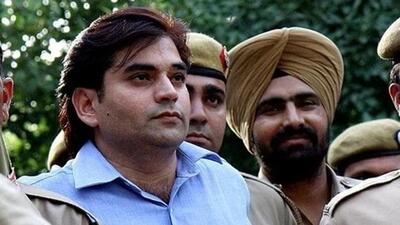
New Delhi: The Delhi High Court on Wednesday dismissed Nitish Katara murder case convict Vikas Yadav’s plea seeking three weeks’ leave to maintain social ties.
Nitish Katara murder case convict Vikas Yadav moved the High Court against the jail authorities on October 29, 2025, rejecting his request for release on furlough.A bench of Justice Ravinder Dudeja held that the jail authorities’ decision to reject Yadav’s furlough request did not suffer from arbitrariness, illegality or any violation of constitutional rights.
“In view of the above, this court does not find any arbitrariness, illegality or violation of constitutional rights in the order dated October 29 or the amendment dated December 1, 2025. The petition is accordingly dismissed,” the court said while announcing the verdict.
A detailed copy of the judgment is awaited.
Yadav moved the High Court against the jail authorities on October 29, 2025, rejecting his request for release on furlough. Jail authorities justified their decision by citing the seriousness of the crime, the severity of the sentence imposed and the victim’s fear that the offender might flee the country, disturb public order or cause irreparable harm to the victim’s family.
More Read

In his plea, argued by senior advocate Vikas Pahwa, Yadav argued that his furlough plea was rejected arbitrarily and without due consideration given that he was earlier granted interim bail by the Supreme Court for four-and-a-half months due to his mother’s medical treatment, which was later extended due to his marriage.
The petition also states that Yadav has been in continuous custody for 23 years and now seeks release to spend time with his wife after his recent marriage. He also claimed that he fulfills the eligibility criteria under Rule 1223 of the Delhi Jail Rules, 2018, which allows leave for prisoners who exhibit good behaviour.
The Delhi Police, represented by special advocate Rajesh Mahajan and advocate Jyoti Babbar and Neelam Katara, represented by advocate Brinda Bhandari, had earlier submitted before the bench that Yadav was not eligible for furlough under the Detailed Project Report (DPR), insisting that the furlough was not absolute and he had every right to remain in jail there. non-liberation
More Read

Mahajan argued that while the DPR requires an inmate to have three annual good behavior waivers, the same cannot be granted to Yadav as his sentencing order mandates a 25-year term without parole.
Nitish Katara’s mother, Neelam Katara, claimed that DPR also required demonstrable good conduct and an unblemished record, which Yadav lacked. Katara, represented by advocate Brinda Bhandari, alleged that his conduct included abuse of judicial process and that his actions disqualified him from furlough, insisting that he had shown no signs of reformation.
Bhandari also claimed that Yadav tried to influence the sitting judges, forged documents, violated bail conditions, received undue benefits and filed false cases even while in custody. He also alleged that since the murder incident, he has repeatedly violated the law, obstructed justice, misled the judiciary, pressured witnesses and public prosecutors and, after being convicted, visited more than 100 unauthorized hospitals with prison and hospital authorities.
Besides seeking furlough, Yadav also filed a separate petition seeking release from jail.
Katra was abducted from a wedding party on the night between February 16 and 17, 2002 and then murdered for his alleged affair with Bharti Yadav, Vikas’ sister.
In May 2008, the trial court convicted Vikas Yadav, son of former Uttar Pradesh politician DP Yadav, Vishal Yadav and their accomplice, contract killer Sukhdev Pehelwan, for kidnapping and burning Katara and sentenced them to life imprisonment. The High Court in February 2015, while upholding the life sentences awarded to Vikas and Vishal, fixed a sentence of 30 years without parole and sentenced Sukhdev to 25 years without parole.
More Read

In July 2016, the Supreme Court commuted the sentences of Vikas and Vishal to 25 years without parole and Sukhdev’s sentence to 20 years without parole. On July 29, the Supreme Court ordered Sukhdev’s immediate release but dismissed Bikash’s plea on the condition that he remain in jail for 25 years without parole, giving him freedom to approach the Delhi High Court. In August 2017, the Supreme Court rejected Yadav’s review petition against the 2016 order.