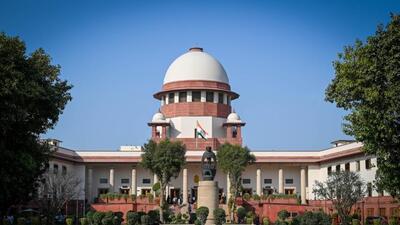
New Delhi: A petition has been filed in the Supreme Court challenging a provision of the Indian Civil Protection Code (BNSS), 2023, which allows sitting or retired judicial officers to hold top posts in the prosecution department, citing concerns that it violates separation of powers and undermines judicial independence.
PS Subish filed the petition through advocate MS Subhidatta, challenging the provision under sub-sections (2)(a) and (2)(b) of Section 20 of the BNSS (representative photo).PS Subish, a practicing criminal lawyer for over two decades, filed the petition through advocate MS Subhidatta on Friday challenging the provision under Section 20 sub-sections (2)(a) and (2)(b) of the BNSS.
The provision in question under section 20(2) states: “A person shall be eligible for appointment, — (a) as a Director of Prosecutions or a Deputy Director of Prosecutions, if he has practiced for at least fifteen years as an Advocate or is or has been a Sessions Judge; (b) as an Assistant Director of Prosecutions or as a Magistrate of the first class if he has not practiced for less than seven years.” This provision proposes to establish a Directorate of Prosecution in all states
The petition said that though the provision aims to strengthen the prosecution, in practice, it subjects it to executive control and disrupts the constitutional balance between the judiciary, the executive and the prosecution.
“By allowing serving or retired judicial officers to occupy prosecutorial leadership roles, the provision erodes prosecutorial autonomy and revives an impermissible combination of powers,” Subish said.
More Read

This further weakens institutional safeguards, compromises prosecutorial independence and undermines the integrity of the criminal justice system, he argued.
“Having direct, first-hand insight into how prosecutorial discretion and institutional controls shape criminal justice in the courts,” said Subish, adding that constitutional guarantees of fairness and individual liberty are most “severely tested in such situations, and impermissibly combining judicial and executive functions undermines the independence of the judiciary.”
“Such importation violates the doctrine of separation of powers, which forms an essential feature of the constitutional scheme. The said provisions, therefore, violate the fundamental rights of the petitioner guaranteed under Articles 14 and 21 of the Constitution of India,” the petition said.
More Read

The petition explains that traditionally, investigation falls within the domain of the police, prosecution is within the discretion of independent public prosecutors, while adjudication rests exclusively with the judiciary. “Section 20 of the BNSS brings these otherwise distinct phases into a single executive-controlled prosecutorial framework and, when read with sub-sections (2)(a) and (2)(b), allows judicial officers to function within that framework,” Subish said.
As a result, judicial officers constitutionally mandated by the Judiciary are legally able to exercise, supervise or influence prosecutorial and investigative functions, which breaks down the functional boundaries indicated in the Constitution between the three organs of the state, he added.
The petition states that sub-sections (7), (8), (9), and (10) under BNSS Section 20 confer broad powers on the Directorate of Prosecutions, including powers to verify police reports, monitor criminal investigations, supervise trials based on the gravity of the offence, expedite the appeal process, and advise on appeals.
The entire prosecution machinery — public prosecutors, additional public prosecutors and assistant public prosecutors — functions under the executive control of the state home department. “The prosecution wing is increasingly placed under the administrative command of the political executive, thereby compromising its independence as an officer of the court,” the petition said.
The petition filed by Subish on Friday named the central government through the home ministry and the law and justice ministry as a party.