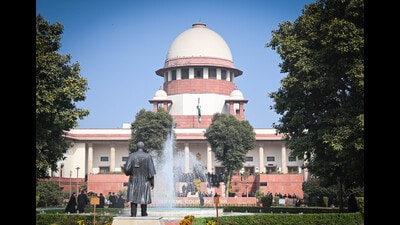
The Supreme Court on Wednesday asked the Madras High Court to decide on the controversial Tamil Nadu law to replace the governor with the state government in appointing vice-chancellors in the state’s universities, preferably within six weeks.
The apex court recorded an undertaking by the state to vacate an interim stay on these laws passed by the high court on May 21, 2025 till the court takes a final decision. (HT Photo)The apex court recorded an undertaking by the state to vacate an interim stay on these laws passed by the high court on May 21, 2025 till the court takes a final decision.
A bench headed by Chief Justice of India (CJI) Surya Kant passed the order on an appeal filed by the state government challenging the May 21, 2025 stay by the Madras High Court without giving them an opportunity to respond.
The petition in the High Court filed by K Venkatachalapathy alleged that the laws amended various rules governing state universities and fell foul of Regulation 7.3 of the 2018 regulations issued by the University Grants Commission (UGC) which prescribes eligibility for recruitment of teachers and academic staff.
A bench comprising Justices Jayamalya Bagchi and Vipul M Pancholi said, “We are not examining the matter on merits, but the manner in which the order was passed.” Referring the matter back to the High Court, the top court said, “Since the original case is pending before the High Court and the impugned judgment (on May 21) is an interlocutory (interim) but in all sense has the effect of a final order, we do not wish to express any opinion on the merits. We only wish to allow the State and the competent authority to be heard before the hearing.”
More Read

Citing this “technical” ground, the order said, “On this ground alone the judgment is set aside and the matter is referred to the Madras High Court.” The CJI-led bench requested the Chief Justice of the High Court to assign the matter to its presiding judge or to a judge of his choice as the current Chief Justice Manindra Mohan Srivastava is just a month away from retirement.
On the court’s order, the state, represented by senior advocates Abhishek Manu Singhvi and P Wilson, submitted that till this date the judgment by the High Court, “no appointment shall be made”. Appreciating the fair stand taken by the TN government, the bench requested the High Court to decide the matter expeditiously and preferably “within six weeks”.
The High Court was further requested to grant reasonable time to the State and the petitioner to file its response with the UGC and submit arguments. The bench clarified that the final order on the merits of withdrawal of the stay and all adverse comments or opinions contained in the May 21 order will not be affected.
More Read

Singhvi told the court that while determining the validity of a law, arguments are heard and then the suspension is considered. “By this order, the state law has been repealed and the UGC regulation has been imposed on the state yet to respond to the matter,” Singhvi said.
Wilson also pointed out that the vacation bench of the high court passed the order despite reservations raised by the state. “The state cannot keep its universities leaderless. This applicant has been installed by the opposition. They are hounding us for every appointment.”
The court put some pertinent questions to the petitioner as it observed that listing the appointment of the Vice-Chancellors on leave is not an urgent matter as the High Court is empowered to set aside any wrongful appointment made by the State. “These are statutory laws with presumption of validity. At the interim stage itself, the statutory rules are suspended. Why should the matter go before the vacation bench. It was a pending matter and it was not filed during the vacation. What was the rush to tear down the bench because heaven will not fall,” the bench observed.
Solicitor General Tushar Mehta appeared for the UGC and senior advocate Dama Sesadari Naidu, representing the petitioner in the High Court, opposed the state’s appeal. Mehta said the UGC regulations are binding on the state as it receives central grants and the HC initially found the state’s amendments to be “contrary” to the central regulations.
Naidu objected to the state’s attack on the bench as “unfair” and “immoral” as he said the TN government was given an opportunity to file a response but since they took time, the bench issued the order.
A High Court bench of Justices GR Swaminathan and V Lakshminarayanan said , “The unconstitutionality and unconstitutionality of the unconstitutionality and unconstitutionality which undermines the law is so obvious that we cannot close our eyes. We are convinced that the amendments are retrospectively unconstitutional. If it allows an unconstitutional process, it will be unconstitutional. Injury and public interest will be harmed.”
More Read

The amendments effected by the state replaced the word “Chancellor” with “Government” in 18 state universities in the appointment of V-Cs as it denied the power of the Chancellor/Governor to accede to the recommendations of the state for appointment as V-C and even removed the VC subject to state orders.