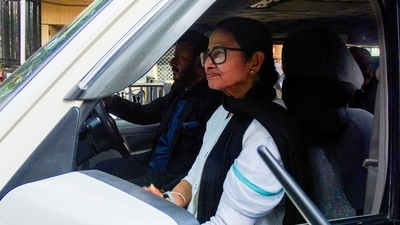
West Bengal Chief Minister (CM) Mamata Banerjee on Wednesday became the first sitting chief minister to personally argue her own petition before the Supreme Court, urging it to “protect democracy” and “people’s lives”, as the court sought a response from the Election Commission of India (ECI) for withdrawing notices to millions of people. of the Electoral Roll (SIR) of his State.
Making a dramatic appearance in a white sari and a black scarf, Banerjee delivered an emotional 15-minute intervention before the bench, quoting Rabindranath Tagore and describing the ECI as the “WhatsApp Commission”. (PTI)Making a dramatic appearance in a white sari and a black scarf, Banerjee delivered an emotional 15-minute intervention in front of the bench, quoting and narrating Rabindranath Tagore. ECI As a “whatsapp commission”. In a packed courtroom, the chief minister repeatedly insisted that he was not fighting for his party, but for voters who risked being excluded from the list due to clerical and linguistic inconsistencies.
“I am from that state… when justice is crying behind closed doors, we felt we are not getting justice anywhere. I am not fighting for my party… please save democracy… please save people’s lives…” Banerjee told the court in English, as she charged the ECI for targeting West Bengal voters ahead of the 2026 elections.
Banerjee’s unprecedented move created a sensation Supreme Court where many lawyers and litigants thronged the corridors to catch a glimpse of him.
Bench of Chief Justice of India Surya Kant And Justices Jayamalya Bagchi and Vipul M Pancholi asked the ECI to act “carefully” while identifying anomalies, fixed February 9 for the next hearing and directed the West Bengal government to propose a list of officers familiar with local dialects who could help the polling panel resolve the errors by excluding genuine voters.
More Read
The hearing marked a rare moment in the Supreme Court, with Banerjee addressing the bench in person, accompanied by senior advocate Shyam Divan, who appeared for her in the matter. Amid a throng of lawyers and supporters, the chief minister reached the Supreme Court around 10 am and sat in the first row for lawyers around 1 pm, when the bench headed by the CJI began the hearing.
Opening the argument, Divan pressed for urgent interim relief, indicating that sir The exercise was close to its deadline despite a large number of voters stuck in the verification process. “Just four days left…unmapped voters are 32 lakh (3.2 million). About 1.36 crore (13.6 million) names are in the logical discrepancy list. 63 lakh (6.3 million) cases are pending,” Divan claimed while placing the figures before the court.
Divan argued that most of these inconsistencies arose from minor spelling differences, variations in pronunciation due to local dialects, or regular changes such as surnames after marriage. “There are about 70 lakh (7 million) name mismatches. These cannot be grounds for striking out names from the electoral roll,” he said, urging the court to order withdrawal of notices issued on such grounds alone.
More Read
The bench acknowledged the concern, noting that inconsistencies arising from dialects and accents were common across the country. “We are not concerned with spelling mistakes,” the court said, adding that genuine voters cannot be excluded on that ground.
Banerjee then requested the bench to allow her to address the court. “If you could allow me five minutes,” he asked. D CJI In response, he said, the court will give him 15 minutes, not five.
Banerjee launched a scathing critique of the SIR process, alleging that it had become an exercise aimed only at erasure, not reform or inclusion. “Even after a woman changes her surname after marriage, they call it mismatch … poor people change houses, buy small flats and suddenly they are wiped out,” he said.
The chief minister alleged that despite the Supreme Court’s earlier directive, voters were being alienated under the guise of “wrong mapping”. “In the name of mapping and inconsistency, they are violating your orders,” he told the bench.
Banerjee also accused the ECI of electorally targeting West Bengal on the eve of the elections. “Why Bengal? Why not Assam?” He repeatedly asked, alleging that the commission completed a process within two months Trying to do that usually takes years.
Referring to the deployment of micro-observers, he alleged that officials were drawn from Bharatiya Janata Party-The ruling states were interfering in the verification process. “This Election Commission – sorry, this ‘WhatsApp Commission’ – is doing all this,” the chief minister remarked, requesting the bench to assure that safeguards could be put in place if needed.
More Read

“I am a bonded laborer sir… I come from a simple family and I am not fighting for my party,” he added.
The Court repeatedly emphasized that the objective was to ensure that no genuine voter was left out. “Every problem has a solution. You must look at the right places for solutions. No innocent citizen should be left out,” it said.
For that purpose, the bench asked Dr West Bengal The government will propose a list of officials familiar with Bengali dialects and local naming conventions who can assist the ECI in identifying and correcting misidentifications. “This will help them,” the court said, adding that it would give such officers time to report back.
At the same time, the bench cautioned the ECI against issuing notices mechanically. “Sensitize your officers. Issue notices carefully. Do not issue notices to notable writers and poets without reason,” it told the selection panel’s lawyers, senior advocates Rakesh Dwivedi and DS Naidu.
Senior advocate Gopal Sankaranarayan appeared for Sahitya Akademi awardee and poet Jay Goswami, another batch petitioner, expressing concern over the arbitrary notice.
Appearing for the ECI, Naidu said the commission is yet to be served with the latest applications and needs time to respond. The bench, however, reminded him of the strict timeline of the SIR exercise. “We cannot afford you the luxury of indefinite time,” the court said. “In principle, if inconsistencies due to dialect or pronunciation are flagged, let us know what you want to do.”
Senior counsel Rakesh Dwivedi, representing the ECI, blamed the state government for not providing enough senior officers to assist in the process. Banerjee strongly disputed the claim, claiming that Class-II officers were appointed and accused the commission of culpability.
Solicitor General Tushar Mehta, appearing for the union, flagged what he described as a “hostile atmosphere” and requested that the ECI’s affidavit be brought on record in the next hearing.
In its operative direction, the court issued notice on the petition filed by Banerjee and Goswami, asked the ECI to respond to the withdrawal of the notice based on minor discrepancies, and directed the state to submit a list of officials who could assist the commission. The matter has been listed for further hearing on February 9.
As the proceedings ended, Banerjee thanked the bench and made a final appeal: “We are very grateful, sir. Please save people’s lives.”
Banerjee’s petition seeks to scrap the revision of West Bengal’s electoral roll altogether, insisting that only the existing 2025 list be used in the 2026 assembly elections. It seeks cancellation of ECI’s SIR orders from June 24 and October 27, 2025 and all related directions. With SIR’s 2002 baseline and “rigorous” verification threatening the rights of genuine voters, especially through spelling mismatches through “logical inconsistencies”, he called for discontinuing such hearings, mandating automatic rectification from records and transparent uploading of cases on the CEO/DEO website. Further relaxations include withdrawal of earlier notices, stop deletion for registered 2002-mapped voters and acceptance of Aadhaar as individual ID proof.