Even as Indian and US officials have been negotiating over the past year to seal a trade deal between the two sides, the Indian government has taken several steps to focus on making the Indian economy resilient and future-proof.
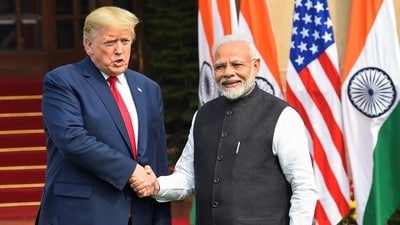
The trade deal was first announced on Monday by US President Donald Trump, who said Prime Minister Narendra Modi had agreed during a phone call to stop buying Russian oil. (PTI/File)The trade deal was first announced by US President Donald Trump, who said Prime Minister Narendra Modi had agreed during a phone call to stop buying Russian oil. Modi, without using the word “trade deal”, thanked President Trump “on behalf of the 1.4 billion people of India” for the “wonderful announcement” to cut tariffs from 25 percent to 18 percent. Track live updates on India-US trade deal
In total, these measures will reduce overall tariffs on many Indian goods from 50 percent to 18 percent. Trump imposed tariffs on India in two phases in August last year, first at 25 percent and later as a “penalty” for buying Russian oil.
D India-US trade agreementwhich was confirmed by Home Minister Amit Shah and others in the central government besides Trump, after months of negotiations involving meetings in both New Delhi and Washington and phone calls between Prime Minister Modi and the US president.
How India Focused on Resilient Economy- A budget increase: The latest development to increase the competitiveness of the Indian economy in the international market came with the Union Budget when labour-intensive industries like textiles, seafood, footwear and leather goods were encouraged. after Trump administration tariffs Effective in August, Indian exports of fish and other aquatic invertebrates fell by 9.2 percent on annual basis. Indian knitwear exports also declined by 3.88 percent to $1.70 billion.

“I propose to increase the duty-free import limit of certain inputs used for processing marine products for export from the current one per cent of the FOB value of the previous year’s export turnover to three per cent,” the finance minister said. Nirmala Sitharaman He said this in the budget speech on Sunday. “I am also proposing duty-free import of certain inputs, which are currently available for export of leather or synthetic footwear, as well as export of shoe uppers,” he added.
Union Minister of Commerce and Industry Piyush Goyal Called it a budget for a “future-ready India” that would see a leap in exports and domestic manufacturing. “With a dedicated focus on accelerating manufacturing growth, increasing exports and positioning India as an attractive investment destination, the Budget reinforces the country’s role as a trusted global economic partner,” he said in a post on X.
The Labor Code applies to: In November last year, the government announced that four labor codes – Wages Code, 2019, Industrial Relations Code, 2020, Social Security Code, 2020 and Occupational Safety, Health and Conditions of Work Code, 2020 – were being implemented. It states that the modernization of labor regulations has laid the foundation for a future-ready workforce and strong industry that drives labor reforms for a ‘self-reliant India’..
More Read

Many of India’s labor laws were enacted in the pre-independence and post-independence era (1930s-1950s), at a time when the economy and the world of work were fundamentally different, the government said in November. It combines 29 Labor Law Among these four comprehensive labor codes. Long-term reforms have moved India beyond the colonial-era framework. In international markets, labor standards, regulatory transparency, and workforce flexibility enhance the economy’s competitiveness, and some of these issues were even discussed during negotiations between India and the United States.
– Quality control orders: Another major development was linked to Quality Control Orders (QCOs), which affect India’s exports and imports as well as market access. QCOs mandate compliance with Indian standards for certain products, which the government sees as a way to ensure quality, protect consumers and support domestic manufacturing. In a move to help the textile sector, which was hit by the US tariffs, the Ministry of Chemicals and Fertilizers in November 2025 immediately canceled 14 QCs including polyester fiber and polyester yarn. Trading partners such as the US often view stricter or faster-imposed QCOs as potential non-tariff barriers that could increase compliance costs and May limit alcohol. QCOs, as a result, are likely to come up in trade negotiations, despite not being explicit clauses in bilateral trade agreements, and they potentially constitute practical terms of trade.
While the details of the Indo-US trade deal have not yet been officially disclosed by the Indian government, the timing of changes related to the labor code and quality control mandate – both of which have historically featured in trade negotiations between the US and its partners – suggests that these steps could contribute to a broader negotiating environment.