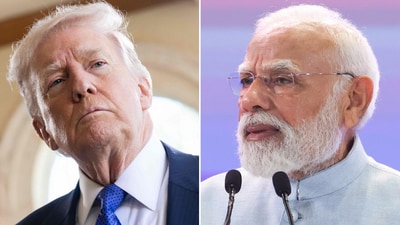
US President Donald Trump considers Prime Minister Narendra Modi “genuinely” a “great friend” – a comment by US Ambassador Sergio Gore that is now borne out by the results. The India-US trade deal announced by the Republican leader, which took nearly a year of tough negotiations and tested both New Delhi and Washington, has finally been sealed, and moreover, it puts India in a stronger trading position than its main regional rivals China, Pakistan and Bangladesh.
US President Donald Trump and Prime Minister Narendra Modi. The US announced the Indo-US trade deal which reduced tariffs to 18%. (file image)under contractthe United States reduced tariffs on Indian goods to 18 percent; With this revised tariff structure, India has lower tariffs than various competing export economies.
Better deal than China, PakistanIndia’s advantage is more pronounced than China’s, where tariffs remain steep at 34 percent. Indonesia faces a 19 percent tariff, while Bangladesh and Vietnam are subject to 20 percent each.
New Delhi also outbid Pakistan, which faces a 19 percent tariff, despite showing warmer ties with Washington in recent months. White House Dinner with Islamabad Army Chief Asim Munir and formal nominations Donald Trump for Nobel Peace Prize.
This shift will position Indian exporters in a more favorable position in multiple sectors, especially at a time when global supply chains are being restructured.
More Read
The tariff reduction is also expected to provide major relief to India’s textile sector, a major employer that is heavily dependent on the US market, where high tariffs have put it at a disadvantage against rivals such as Bangladesh, Vietnam and China.
Modi welcomed the tariff reductionPrime Minister Narendra Modi welcomed the announcement Trump is a “dear friend.” and highlighting immediate benefits for Indian exporters.
“Wonderful to speak to my dear friend President Trump today. Delighted to announce 18% tariff reduction on products made in India. Big thanks to President Trump on behalf of the 1.4 billion people of India for this great announcement,” PM Modi wrote in a post on X.
More Read
Trump mentioned his friendship with ModiEarlier on Monday, US President Donald Trump announced the two countries “A trade deal has been agreed upon.”reduced the reciprocal tariff in India from 25 percent to 18 percent
He said the decision was taken “out of friendship and respect” for PM Modi and would be “effective immediately”.
In a post on Truth Social, Trump referred to a conversation with Modi earlier in the day, describing the Indian prime minister as one of his close friends and a powerful world leader.
“It was an honor to speak with Prime Minister Modi of India this morning. He is one of my greatest friends and a strong and respected leader of his country. We talked about many issues, including trade and ending the wars with Russia and Ukraine. He has agreed to stop buying Russian oil and buy more from the United States and potentially Trump’s Venezuela.”
In accordance with his request, effective immediately, we have agreed to a trade agreement between the United States and India, whereby the United States will charge a reduced reciprocal tariff, from 25% to 18%,” it added.
Trump also said India will reduce tariff and non-tariff barriers against the US as part of the deal.
Separately, a White House official confirmed to HT that Washington will also withdraw an additional 25 percent tariff imposed on Indian imports for New Delhi’s purchases of Russian oil.