

PC: Vintage Aviation News
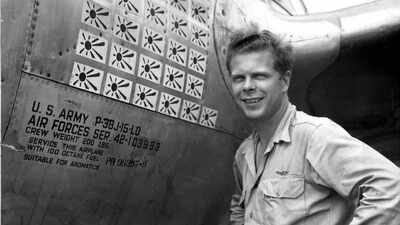
The remains of a fighter plane belonging to one of the greatest fighter pilots of World War II, Richard Bong, are believed to have been found in Papua New Guinea. The plane, named “Marg”, disappeared in March 1944 after an engine failure while flying over the area currently called Madang Province.
The exploration was conducted by people associated with the organization “Pacific Wrecks” and the Richard I. Bong Veterans Historical Research Center. There are indications that the serial numbers written on the metal fragments that were found match the aircraft’s registered numbers. The plane was found in the forest, and remains difficult to access; Hence it survived in its broken form.
World War II planes The wreckage was discovered in a dense forest ravine in Madang Province years later
The wreckage was found in a remote, forested area of Madang Province in Papua New Guinea.
The site is deep within dense forest, where travel is difficult and visibility is limited. The search team included members of Pacific Wrecks and representatives associated with the Bong Historical Center. They have been following historical records and local leads for several years.Initially, the team was directed to a different crash site in the area. This site turned out to be a Japanese plane, not the missing American fighter.
The search continued inside. Eventually, the team reached the valley. The terrain was steep and covered in vegetation and soil. Metal fragments were visible at various points along the slope.At the top of the valley, parts of aircraft engines were found partially buried in the ground. The situation suggested a nose-first impact on the terrain.
How physical evidence and serial numbers helped identify the aircraft
Aircraft identification depends on various physical features found at the crash site.
There were marks on small pieces of metal that were closely analyzed by the group. One of these coins is said to be inscribed “Model P-38 JK.” Another piece of metal bore numbers that appeared to be part of the plane’s serial number, although some of the numbers were not clearly visible due to corrosion, the Associated Press reports.Part of the wing also contains numbers that were probably the last few digits in the aircraft’s serial number, although these are difficult to clearly decipher.
There were traces of red paint on the wrecked plane. Historical accounts indicate that Bong’s plane was called the “Marge”, and its wings were painted red.
Richard I-Bong and his rise as America’s best fighter in World War II
As the Associated Press reported, Richard I. Bong was one of the most famous American fighter pilots of World War II. Born in Poplar, Wisconsin, he became a highly skilled pilot while serving in the Pacific Theater.He flew a Lockheed P-38 Lightning, an aircraft he named “Marge” after his girlfriend, Marge Vattendahl.
Bong is officially credited with 40 aerial victories, making him the highest-scoring American ace of the war. During his combat service, he reportedly achieved multiple victories while flying the “Marge” aircraft. Historical records indicate that three confirmed enemy aircraft were shot down during missions involving that specific aircraft.Bong received the Medal of Honor in 1944, one of the highest military awards in the United States.
His reputation grew significantly during the war due to his combat record. In 1945, Bong died during a test flight in California while flying a different aircraft, a P-80. His death occurred on the same day as the atomic bomb was dropped on Hiroshima.
The World War II “Marge” Plane Crash: From Engine Failure to Long-Lost Wreckage
The plane, believed to be a “Marge”, went down in March 1944. At that time, another pilot, Thomas Malone, was flying the plane. Reports indicate that an engine failure led to a loss of control.The plane went into a spin and crashed into dense jungle terrain. Malone survived after being rescued from the plane before impact.After the accident, the plane was lost in the dense forest and remained undiscovered for decades. Its exact location has been uncertain, despite historical documentation and continued interest from aviation researchers.