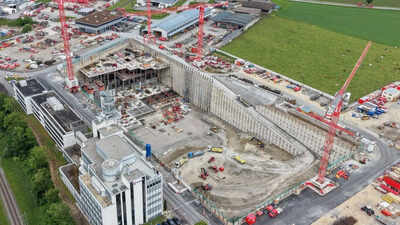
There’s something unusual going on deep in Switzerland, and it hasn’t received much attention outside energy circles until now. Engineers are building what could become one of the world’s largest underground energy storage systems, designed to store renewable electricity on a large scale and release it when the grid is under stress.Initial reports indicate the system could hold about 2.1 gigawatt hours of power and provide up to 1.2 gigawatts of power, enough to supply approximately 210,000 homes for an entire day. It is being developed by Flexbase with support from Invinity Energy Systems, and is expected to be completed by 2029.
Inside the world’s largest underground battery in Switzerland: What makes this battery unique?
At first glance, calling it a “battery” might be a bit misleading. This is not the type of system you would find in a phone, car, or even a typical network storage station.Instead, it uses vanadium redox flow technology, which stores energy in liquid electrolytes held in large tanks. When electricity is needed, fluids are circulated through the system to generate power. This design choice changes everything.Unlike lithium-ion systems, which degrade slowly over time, flow batteries behave more stably over long cycles. Engineers say they can operate for decades with much less performance loss.
Other details matter more than people realize. The system is non-combustible, making it safer for large underground deployments where thermal hazards are a critical concern.
How it can power 210,000 homes without breaking a sweat
The title number seems almost abstract until you break it down. At full capacity, the system stores 2.1 GWh of electricity and can release power at a rate of 1.2 GW. In real terms, this electricity is enough to supply about 210,000 homes with energy for 24 hours.But here’s what makes it more interesting. This isn’t just about overall power. It’s about timing. Electricity demand is chaotic. It rises in the morning, then rises again in the evening, and falls overnight. Power grids have to balance this second by second, or they risk instability.This system is designed to react almost instantly, releasing stored energy when demand suddenly spikes. Think of it less as a backup generator and more as a shock absorber for the entire grid.It is also strategically located near the Star of Laufenburg substation, one of the major electricity interchanges in Europe linking Switzerland, Germany and France. This site is not random. It is located where cross-border energy flows are constantly changing.
Why engineers are moving beyond lithium-ion
Lithium-ion batteries dominate everything from phones to electric cars, but they’re not ideal for long-term network storage. Flow batteries are gaining attention because they solve a completely different problem.Instead of packing power and energy into one compact unit, they separate the two. This means that power capacity can be expanded without redesigning the system itself.Engineers point to three reasons why this is important:
- They last longer with slower degradation
- They are widely safer
- It can be expanded in a modular way
An unexpected connection with AI data centers
One detail that makes this project stand out is its connection to a 500 MW AI data center complex that is being developed alongside it. AI systems are very energy intensive, and demand is growing faster than most networks can comfortably handle.
Training models and running large-scale computing infrastructure require constant, stable electricity.By pairing a massive storage system with a data center, the idea is to reduce energy demand and reduce reliance on fossil fuel backup power during peak usage.
Why is this project more important than it seems?
The real problem with renewable energy is no longer its generation, but the timing. Solar energy peaks at midday. Wind energy depends on weather conditions.
But electricity demand follows human behavior, not nature.This underground system is designed to fix exactly that. It stores excess renewable energy when supply is high and releases it when demand is high.If scaled successfully, systems like these could:
- Reducing pressure on national networks
- Reducing dependence on backup fossil fuel plants
- Improving cross-border energy sharing in Europe
- Making renewable energy much more reliable in practice
There is a quiet but important shift happening here. Energy is no longer limited to producing more. It’s about controlling when and how it is used.