Far out in the southeastern Indian Ocean, a vast, largely unexplored expanse of seafloor is reshaping how scientists understand the history of the deep ocean. The seafloor, hidden within the Diamantina fault zone, is characterized by long scars, deep trenches and ridges that sink into near-total darkness under intense pressure.
Across this 1,200-kilometre corridor, whale remains have been discovered in surprising abundance, ranging from ancient fossils to relatively modern carcasses that still support deep-sea ecosystems. Some bones appear to be heavily mineralized, effectively incorporated into the surrounding rock, while others continue to sustain life through slow environmental cycles. In certain areas, the remains of ancient whales lie alongside newer “whale falls,” creating multi-layered records of life in the ocean.
This unusual concentration offers a rare glimpse into millions of years of marine evolution and deep-sea ecological continuity.
Scientists draw the largest mapWhale Cemetery “In the deep Indian Ocean region
The site lies within the Diamantina Fault Zone, a fractured area of the seafloor marked by trenches and high ridges across the floor of the Indian Ocean. It extends for approximately 1,200 kilometers, and in some places descends to about seven kilometers below the surface of the Earth, according to the British Broadcasting Corporation (BBC). At those depths, even modern submarines operate cautiously, which is part of the reason why large parts of the area remained largely unexamined until recent years.
What is now recorded across it is unusually dense. Whale fossils appear in clusters and scattered spots, and some are so mineralized that they appear absorbed into the surrounding rock. Others are more recent, still forming part of slow-moving ecosystems that persist long after the carcass first sinks. Numerous research dives were conducted across different sections of the area, each one adding small pieces to a much larger picture.
Over the course of dozens of landings, hundreds of whale-related sites were recorded, ranging from ancient fossils to active whale falls where carcasses continue to support life on the seafloor.The study, published in the journal Nature, is titled “5.3-million-year-old deep-sea whale graveyard in the Diamantina region,” the time scale is what makes the record difficult to ignore. It is estimated that some of the remains date back more than 5.3 million years, which places them at a very early stage of ocean evolution.
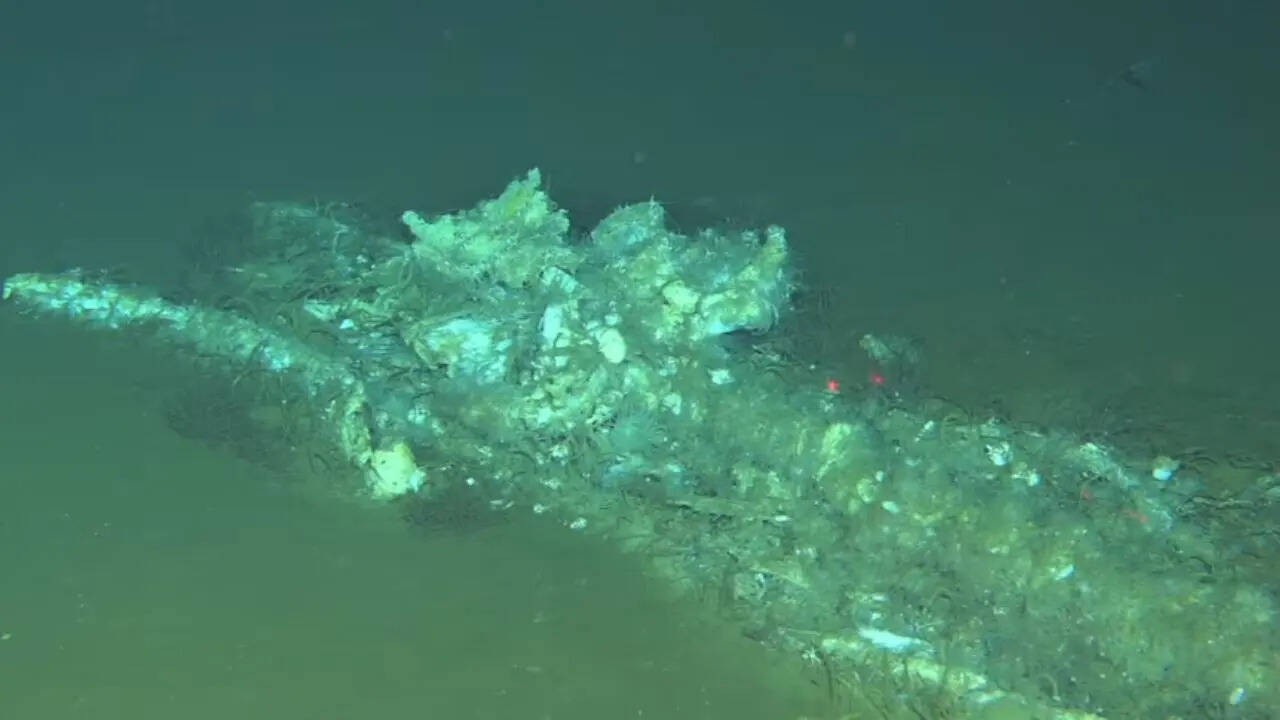
Among the discoveries are skull fragments associated with extinct whale species, including beaked forms that are no longer found in modern seas. Alongside them, more familiar remains were found, such as the carcass of a minke whale, which still hosts a well-developed deep-sea ecosystem.
PC: ABC
Scientists notice new species in the deep sea around whale falls
Around these remains, life forms in slow, irregular patterns. Jellyfish drift near the sea floor, while worms and crustaceans collect in and around the skeletons where nutrients remain.
None of this is unusual in deep-ocean environments per se, but the size and spread across such a wide region has drawn attention.Some organisms collected from the site may not fit well into known taxa. This possibility is still being studied, and reflects how limited direct observation is in these extreme environments where food arrives in rare but important bursts.“For Peng and his colleagues to encounter an extensive fossil cemetery is a truly unique discovery,” said Stephen J. Godfrey of the Calvert Maritime Museum.
Parts, nomenclature and incomplete catalogs
Within the fossil material, scientists have identified remains associated with extinct whale species, including specimens attributed to Pterocetus benguelae. Another has been described as Pterocetus diamantinae, named after the fracture area where it was recovered.Much of the work to date has involved repeated sampling rather than one complete excavation. Each dive adds parts to a growing list, but the picture remains uneven.
Some parts of the seafloor are crowded with remains, while other parts appear relatively empty, shaped more by sediment and rock than by biological artifacts.Even after several expeditions, large parts of the system remain unvisitable. At these depths, every descent is limited by time, conditions and equipment carrying capacity. What has been mapped so far confirms the scale, but the broader structure of the site remains partly unresolved, awaiting further journeys back to the same dark corridor at the bottom of the ocean.