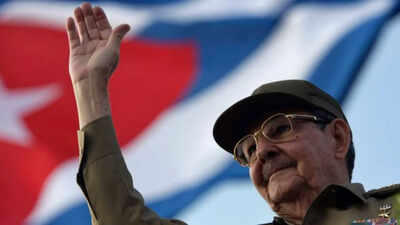
The United States’ accusation that Raul Castro shot down civilian aircraft in 1996 raised tensions between Washington and Havana, with some analysts warning that the move could push the Cold War rivals closer to open conflict.The charges against the 94-year-old former Cuban president were announced this week in Miami, where Cuban exile groups welcomed the decision as long-awaited justice for the deaths of four Cuban Americans killed when Cuban fighter jets shot down two planes operated by the Brotherhood of Rescue group in 1996.But in Cuba, Raúl Castro’s supporters still consider him one of the main symbols of the communist revolution founded alongside his revolutionary brother Fidel Castro.“He is the living embodiment of the revolution,” former US diplomat Ricardo Zuniga told CNN.Zuniga participated in secret negotiations that restored diplomatic relations between the United States and Cuba during the Obama administration. He warned that the indictment could lead to a severing of communication between the two governments and make tensions more serious.“Ultimately, frustration on both sides could lead to conflict simply because Washington closed off communications with the Cuban government through this indictment,” he said.
These accusations come at a time when Cuba is already facing one of the worst economic and humanitarian crises in decades. Fuel shortages, food scarcity and prolonged power outages have fueled growing frustration across the island, while new US sanctions and restrictions have increased pressure on Havana.US President Donald Trump has criticized the Cuban government in recent months while also indicating that he remains open to a potential deal.“I can (make a deal) whether I change the regime or not. It was a cruel regime and they killed a lot of people,” Trump said on Tuesday.“But it’s a country that really needs help,” the president added. “They can’t turn on the lights, they can’t eat. We don’t want to see that.”Meanwhile, Secretary of State Marco Rubio, a Cuban-American and longtime critic of the Castro family, has taken a harder line. He believes that the current leadership in Cuba should be removed from power.The indictment emboldened anti-Castro groups in Miami, many of whom believe that Cuba’s communist government is weakening and could eventually collapse under the pressure.“Castro’s time is over,” Cuban-American Congresswoman Maria Elvira Salazar said on X.For Cuban exile communities, the 1996 downing of the plane remains one of the most painful chapters in U.S.-Cuban relations. The Brotherhood of Rescue planes were carrying out missions related to Cuban refugees, and had previously dropped anti-government leaflets over Havana.
Cuban authorities at the time insisted that the planes had violated Cuban airspace and defended the attack as an act of national sovereignty.Now the indictment may create the conditions for a direct confrontation if the United States tries to pursue Castro more aggressively. In theory, the charges could provide a legal basis for extradition efforts or other actions against senior Cuban officials.Cuban President Miguel Díaz-Canel responded defiantly, accusing Washington of trying to impose political change on Cuba. The Cuban military has increased its training across the country, while state messages have warned citizens to prepare for possible aggression, CNN reports.Díaz-Canel also warned that any invading force would be in for a “bloodbath.”Analysts say that any military confrontation would carry great risks despite Cuba’s weaker military position. Unlike Venezuela, where the United States has recently increased pressure on the government of Nicolas Maduro, Cuba’s political and military leadership remains tied to the revolutionary regime that Fidel and Raúl Castro built over decades.Although he officially stepped down from power years ago, Raul Castro still wields enormous symbolic influence within Cuba.
He is regularly referred to as the leader of the revolution, and senior officials continue to consult him on major decisions.Zuniga warned that completely isolating the Cuban leadership would make the situation more volatile, not less dangerous.“On the Cuban side, by cutting off communications, they may fail to appreciate that the next phase here from the American side could be some kind of attack,” he said.“But there’s not much that can be destroyed without it being already dilapidated,” he added.