

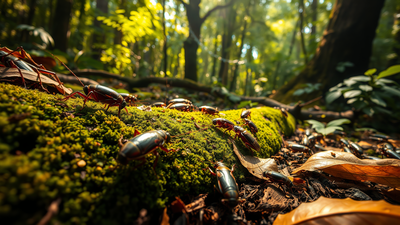
Cockroaches have a reputation problem. Most people picture them running across the kitchen floor, but this image only applies to a small portion of the group. The Earth is home to thousands of species of cockroaches, the vast majority of which live far from human homes, spread across forests and other natural habitats where they quietly go about their lives without ever bothering anyone.
Only a few species, most notably the German cockroach and the American cockroach, have transitioned to living alongside humans, and understanding how they do so tells us a lot about how a wild insect becomes an unwelcome guest in a home.
How many cockroach Species actually exist
The Earth is thought to host about 4,600 species of cockroaches, yet none have spread as widely as the German cockroach, Blattella germanica, which is now found almost anywhere humans live permanently, according to a study titled “Solving the 250-Year-Old Mystery of the Origin and Global Distribution of the German Cockroach, Blattella germanica,” published in the Proceedings of the National Academy of Sciences.
The vast majority of cockroach species never make this jump, and remain attached to the wild habitats in which they naturally evolved, making the handful that have moved inland stand out as the true evolutionary exception rather than the rule.
The few species that have learned to live with humans
Researchers studying the genetics of the German cockroach describe it as one of about six species of cockroaches that commonly live in human structures around the world, along with other species such as the American cockroach and the oriental cockroach.
What distinguishes the German cockroach even among this small group is that, unlike its relatives, it has no known natural range anywhere in the wild, having become completely dependent on human structures for survival.
Unlike many other pest species, which still maintain natural populations in diverse habitats, the German cockroach relies solely on human activity and man-made structures to exist at all, noted Texas A&M University entomologist Edward Fargo, a co-author of the study.
Tracing the German cockroach to its Asian origins
Using genetic data from 281 cockroaches collected from 17 countries and six continents, the research team found that the German cockroach evolved from an outdoor-dwelling Asian species called Blattella asahinai about 2,100 years ago. According to Harvard evolutionary biologist Qian Tang, lead author of the study, the species likely adapted to life alongside humans after farmers cleared its natural habitat somewhere in the Bay of Bengal region, most likely India or Myanmar, and pushed the insect out of fields and into nearby human settlements in search of shelter and food instead.
Why do these few types stand out from the rest?
Most cockroach species remain in their natural habitat and never interact with humans at all. The species that adapted succeeded because they found ways to grow specifically within human-built environments: kitchens, sinks, warm buildings and food storage areas, all of which provided shelter and food scraps that helped them reproduce successfully inside homes. This represents a fairly narrow evolutionary path, since survival inside human structures requires enduring artificial lighting, constant human activity and clean-up procedures that would push away rather than attract most wild species.
How did humans carry cockroaches around the world?
The same research found that once the German cockroach adapted to live with humans, its global spread followed human trade and travel almost entirely. The study identified one migration route heading west toward the Middle East about 1,200 years ago, and a separate route eastward linked to colonial-era European trade routes about 390 years ago. This pattern strongly suggests that the insect’s global dominance was not driven by its particular biology, but rather by centuries of human movement, travel, and trade, which carried it steadily farther from its original range with each new trade route.
A story shaped as much by humans as by cockroaches
Taken together, the story of household cockroaches is actually a story about a very small subset of a much larger family of mostly harmless species. Thousands of cockroach species still live quietly in their natural environments around the world, while only a handful, led by the German and American cockroach, are the exceptions, not because they are somehow more advanced than their relatives, but because they have proven to be extraordinarily good at exploiting the delicate conditions provided by human structures, and extraordinarily adept at traveling wherever people go next.