

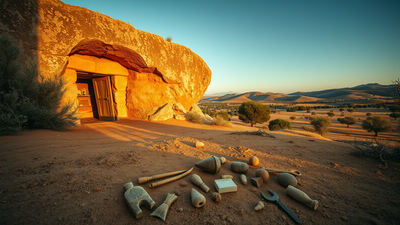
Archaeologists working in Sardinia have discovered three previously unknown prehistoric megalithic tombs, known locally as Domus di Janas or Fairy Houses, adding new depth to a site that has already been studied for decades.
The discovery was made at the archaeological complex of Sant’Andrea Prio in the town of Bonorva, where officials say the new tombs bring the total number of known underground burial chambers at the site to twenty. According to an official statement issued by the Regional Secretariat of the Italian Ministry of Culture in Sardinia, the newly discovered structures date back thousands of years and were identified after archaeologists noticed unusual features in the ground between two already excavated tombs.
How archaeologists discovered three hidden prehistoric tombs in Sardinia
The discovery was made as part of a wider excavation, restoration and conservation project covering the Sant’Andrea Priu complex along with two nearby Nuraghe sites, Nuraghe Oes and Nuraghe Santu Antine. According to the official statement issued by the Regional Secretariat of the Ministry of Culture of Sardinia, the project has been financed with approximately two million euros and is being implemented in cooperation with the Supervisory Authority for Monuments, Fine Arts and Landscapes of the Provinces of Sassari and Nauru. The three newly identified tombs are arranged in a fan shape radiating outward from an already known chamber called the hearth tomb, suggesting that the burial ground expanded outward from this central point over time.
What does the name of fairy houses mean in reality
The term domus de janas translates to fairy houses, a name rooted in ancient Sardinian folklore that envisioned these rock-cut rooms as the dwellings of mythical creatures believed to protect children and guard hidden treasures. Despite their whimsical name, the structures served a much more grounded purpose. According to the ministry’s statement, these tombs were carved directly into the rock and often reproduce architectural details found in the homes of the living, along with symbolic decorations associated with religious practices and rituals, providing researchers with a rare physical record of how prehistoric societies thought about death and the afterlife.
Artifacts with thousands of years of use
Excavations in the new chambers have revealed a wide range of objects, including ceramic vessels, obsidian fragments and metal tools, indicating activity across several distinct historical periods rather than a single burial event. Patricia Luciana Tomasetti, who is leading the project for the regional secretariat, noted that the pottery, obsidian and mineral finds unearthed from within the tombs help reveal the complex layers of the site, which extend from the Neolithic period through the Roman era and into the early Middle Ages.
One of the three newly discovered chambers has been named the Tomb of Roman Vases due to the large number of Roman-era pottery pieces recovered from within it, suggesting that the tomb may have been revisited or reused long after its original construction.
The site is now recognized on the UNESCO World Heritage List
This latest discovery comes shortly after the wider network of Domus di Ganas sites across Sardinia received UNESCO World Heritage recognition, a designation that was confirmed on 12 July 2025.
Bonorva itself figures prominently within that wider list, as it is home to two of the 17 UNESCO-listed cemeteries, Sant’Andrea Prio and Sa Pala Larga. Officials involved in the project said this new discovery usefully adds to existing knowledge about the Domus de Ganas tradition, reinforcing Bonorva’s importance within the wider network identified by UNESCO of prehistoric burial sites across the island.
Why this discovery is important for understanding prehistoric Sardinia
Local officials who attended the announcement, including Bonorfa Mayor Massimo D’Agostino and representatives of the regional Ministry of Culture, described the discovery as an important addition to the region’s historical record. With the newly discovered tombs already available to visitors, the project underscores a broader effort to balance ongoing scientific excavation with public access to the site. As restoration and excavation work continues across the wider Sant’Andrea Prio complex, researchers expect to conduct further study of these newly opened rooms to deepen understanding of funerary customs and social organization across the different societies that used this landscape over thousands of years of continuous and multi-layered history.