

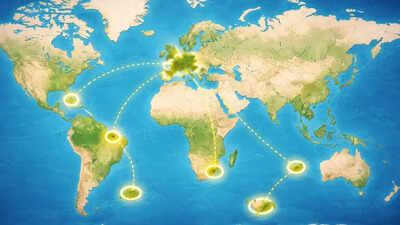
France has the largest number of time zones of any country in the world, with a total of 12 time zones. This includes the mainland as well as French overseas territories, which are located in different parts of the world.While mainland France uses Central European Time, which is equivalent to UTC+1, French overseas territories are located in various parts of the world, including the Caribbean, Pacific and Indian Oceans, as well as near South America.Each of these sites uses its own local time, based on geographic location rather than national time.Therefore, French time zones are distributed across different UTC offsets, which is the main reason why France has the largest number of time zones in the world, not the size of the French land area itself.
How are the 12 time zones distributed in France?
The time zones of France are located in Europe, the Caribbean, South America, the Indian Ocean and the Pacific Ocean. Each region is subject to a specific time zone depending on its location in relation to Coordinated Universal Time (UTC).Guinness World Records indicates that France covers 12 time zones. This number may rise to 13 when other regional time differences are taken into account.Some of the time zones in France are French Polynesia, which is at UTC-10, Reunion, which is at UTC+4, New Caledonia, which is at UTC+11, and Wallis and Futuna, which is at UTC+12.
This is because these places are far from each other.
The role of overseas territories
The overseas territories of France are the main reason for the total of 12 time zones. Overseas territories include Guadeloupe, Martinique, French Guiana, Reunion, Mayotte and French Polynesia.Each region has its own local time zone. Time zones for regions are not adjusted based on mainland France, but rather based on the longitude of the region.Because the regions are located in the Eastern and Western Hemispheres, they cover a wide range of Coordinated Universal Time (UTC) offsets.
How are time zones determined?
Time zones are also based on the Earth’s rotation and are expressed in Coordinated Universal Time (UTC). The Earth is divided into 24 major time zones representing 15 degrees of longitude.Countries use different time zones depending on their geographic location, but administrative procedures also affect the use of time in a country.In the case of France, different overseas countries use different time zones depending on their geographical location.
Comparison with other countries
France has the largest number of time zones compared to other countries. Russia and the United States have 11 time zones each.Russia spans 11 time zones from west to east over a continuous landmass. The United States extends across 11 time zones over its own territory and other territories, including Alaska and the islands in the Pacific Ocean.Other countries with overseas territories, such as the United Kingdom, have lower time zones.
Why does France have the largest number?
The 12 time zones in France are a result of the cosmopolitan distribution of its territory. This is because these areas are spread over a greater longitudinal distance compared to other countries.As a result, different time zones are formed within a country due to the latitudinal difference, as time zones are a result of longitude.Each zone uses its own standard time, which contributes to the total number of time zones.