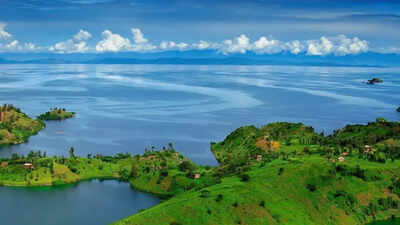
Something unusual is sitting quietly in central Africa, and it doesn’t seem dangerous at first glance. A wide, tranquil lake stretches across the landscape, reflecting the sky like any other picturesque body of water.
However, a completely different world exists beneath its surface. Experts say huge amounts of gas are trapped under intense pressure, including methane and carbon dioxide. The lake appears stable on the surface, but scientists often warn that this balance may not last forever. Around its shores, millions of people live their daily lives, most of them unaware of what lies beneath. It is this contrast between calm waters and hidden dangers that makes Lake Kivu one of the most monitored lakes in the world.
Hidden gas layers in Lake Kivu and the possibility of its explosion
Lake Kivu lies on the East African Rift, a massive tectonic system that causes the African continent to break apart over time. This process occurs gradually, but its influence can be seen in the formation of all surrounding features. Lake Kivu is located in the region bordering Rwanda and the Democratic Republic of the Congo, and is a densely populated area with towns and villages close to the lake’s shore.
Geologists have determined that the rift valley is volcanically active, with heat and gases interacting beneath the lake. Volcanic activity causes gases to emerge from the volcano and dissolve in the deep layers of the lake. The result is a unique chemical stratification within the lake.
How temperature and pressure trap gases within the lower layers of Lake Kivu
At the bottom of Lake Kivu there are significant differences in conditions compared to those on the surface.
Water is colder, denser and under tremendous pressure. Carbon dioxide is soluble in such conditions, and methane accumulates due to biological processes in lake sediments.According to experts, Lake Kivu has a strong stratification; This means that the layers of water do not interact well with each other. At the bottom there is a layer of warm water filled with gas, and above it is a layer of cooler water, which acts as a cover for the gases, preventing their release.
Specialists are concerned about any potential disturbances that may occur due to temperature changes, earthquakes or rainfall cycles.
1986 Lake Nyos disaster: A silent explosion turned the lake into a deadly gas cloud
A similar catastrophic liminal eruption occurred in 1986 when carbon dioxide exploded from Lake Nyos into the sky in a cloud-like form in Cameroon in 1986. This was when it displaced oxygen in the area and spread throughout the valleys.It was reportedly an uneventful but deadly operation as it led to the deaths of between 1,700 and 1,800 people and thousands of animals.
The villages located near the lake were not prepared for this event. According to experts, the gas cloud acted like a wave, moving to the lower regions, thus suffocating anything that used oxygen.
How do scientists effectively control the hidden gas threat in Lake Kivu?
However, unlike Lake Nyos, Lake Kivu is under constant supervision, and scientists and engineers have made efforts to reduce the threat by regulating the gases found beneath its surface.Methane is extracted from deep water levels using pumping equipment.
The gas is then brought to the surface where it is separated and used as an energy source. It appears to be used to generate electricity which is then used by neighboring communities and also as cooking gas, reducing the use of firewood.On the other hand, carbon dioxide is regulated and injected back into the depths of the lake. This is said to be done in order to regulate the pressure levels within the lake.
What is the current status of Lake Kivu?
Even with engineering systems in place, scientists continue to closely monitor Lake Kivu. Seismic activity, volcanic movements and gas concentrations are regularly tracked. The area remains geologically active, so conditions can change over time.Millions of people live near the lake, including large urban populations in Goma, Gisenyi and Bukavu. Daily life continues normally, with fishing, trade and transportation taking place across the water. But experts say the platform requires constant attention.For now, the balance is in place. Gas is used, pressure is controlled, and the lake remains calm. But the story of Lake Kivu is far from over. And it’s still unfolding, slowly, under pressure that never goes away completely.