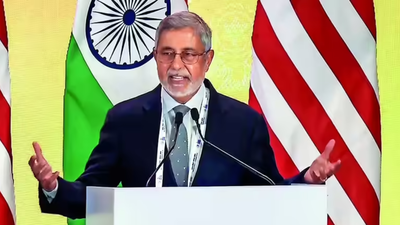
TOI correspondent from Washington: In the summer of 1976, a Kanpur-born teenage engineering student from BITS Pilani stood in the lobby of the US Embassy in New Delhi after being denied a student visa for the third time.
His father, who accompanied him, refused to leave. He saw the photo of the consular officer in the lobby, discovered he was out to lunch, and decided to wait to ask him why his son had been denied a visa even though he had confirmed admission to three universities and all documents were in order. Persistence succeeded. Half a century later, that student, Sanjay Mehrotra, is the CEO of Micron Technology, the memory chip giant that, driven by the artificial intelligence craze dominating Wall Street, on Tuesday surpassed the trillion-dollar market capitalization to break into the ten largest US companies by valuation, overtaking more famous giants such as Walmart, Berkshire Hathaway and JPMorgan Chase.
It’s one of Silicon Valley’s most unlikely stories: a boy repeatedly rejected by the United States became CEO of one of the hottest American tech companies in the MAGA era.
He’s not alone. Mehrotra’s rise also completes an unusual tableau at the top of corporate America. Three of the world’s most valuable technology companies – Microsoft, Alphabet, and Micron, all with market capitalizations of more than a trillion – are now run by Indian-origin executives who arrived in the United States as middle-class strugglers with little engineering talent, parental sacrifice, and a quiet fire in the belly. Satya Nadella grew up in Hyderabad, the son of a government employee. Sunder Pichai grew up in a modest apartment in Chennai where the family once shared a rotary telephone.
Mehrotra also came from a middle-class family in Kanpur that didn’t even have a phone. Calls to his parents during his early years in the United States were always made via “PP” – “Padosi ka phone” – calling a neighbor with a landline who would then call his parents. Amazingly, their collective rise is now reshaping Silicon Valley and the political debate about globalization in America that Donald Trump is fueling.Unlike Pichai and Nadella, who inherited already dominant software empires, Mehrotra’s achievement was more industrial and more difficult.
Memory chips are cyclical, require a significant amount of capital, and have historically been dominated by Asian giants such as Samsung Electronics and SK Hynix. When Mehrotra became CEO of Micron in 2017, the company was valued at about $20 billion. Today, amid a boom in demand for the high-bandwidth memory chips that power data centers, driven by artificial intelligence, Micron has reached the $1 trillion threshold.
Wall Street’s sudden infatuation with Micron—the stock is up 180% in 2026, including 75% in May alone—reflects an apparent realization: AI may run on Nvidia processors, but it remembers through Micron’s memory.
The rally driving Micron has become so feverish in recent days that President Trump personally hailed the company as “one of the hottest stocks” after hosting Mehrotra at the White House, amid allegations of insider trading after Trump’s acquisition of Micron shares worth roughly $50,000 to $100,000 came to light.
Trump later took Mehrotra with him on his trip to China as part of a high-level trade delegation — a remarkable embrace from a president whose political movement has often attacked globalization and immigration.This tension now defines the Indian-American CEO moment in modern America that goes beyond the tech troika. MAGA activists and economic nationalists increasingly accuse Indian-led technology companies of outsourcing jobs, favoring Indian engineers in hiring, and maintaining divided loyalties between the United States and India. In recent days, IBM’s Arvind Krishna — another Trump favorite — has come under attack from right-wing activists angry about the company’s huge Indian workforce.
Similar accusations have periodically followed Microsoft’s Nadella and Google’s Pichai. Yet the same White House that opposes globalization is relentlessly courting these executives because they now control companies central to America’s technological edge against China. Few industries illustrate this contradiction more sharply than memory chips, which Micron has made a significant inroad into in India, following projects in Singapore, Taiwan, Japan, China and Malaysia. The company is investing more than $800 million of its own capital to build an ATMP (assembly, test, labeling and packaging) facility in Sanand, Gujarat, as part of India’s $2.75 billion bid to enter the global semiconductor supply chain. The Sanand facility is rapidly hiring engineers, automation specialists, manufacturing experts and quality technicians for the 500,000-square-foot cleanroom space, one of the largest single-story assembly and test cleanrooms anywhere in the world, as India races to transform itself from a software services back office into a hardware manufacturing hub.For Mehrotra, it’s more personal. Unlike many Silicon Valley executives who maintain only ceremonial ties with India, he has repeatedly portrayed Micron’s expansion in India as a long-term strategic investment in engineering talent and manufacturing depth. The symbolism is important: the student who was once denied entry to America now helps define the semiconductor relationship between America and India.However, the similarities to Nadella and Pichai are striking.
Under Nadella, Microsoft’s market value has risen tenfold — from about $300 billion in 2014 to more than $3 trillion today, largely through cloud computing and artificial intelligence. Pichai, who became CEO in 2019, has overseen a four-fold increase — from $1 billion to a club worth more than $4 trillion that has just one other member, Nvidia. This is done while navigating antitrust battles, AI disruption, and political scrutiny over search dominance.
The three men share certain managerial traits: a simple demeanor, engineering obsession, stage-managing, and an aversion to Silicon Valley celebrity culture.
It’s nothing like the boastful founder archetype popularized by other tech moguls like Elon Musk and Jeff Bezos. They are smooth operators, not showmen. In an industry once dominated by charismatic leavers – Steve Jobs, Bill Gates, Larry Ellison – corporate America has quietly turned toward technocratic immigrant CEOs with deep managerial discipline.This transformation is not accidental. The age of AI increasingly rewards operational complexity, supply chain coordination, and geopolitical balance rather than pure product appeal.
Mehrotra embodies this transformation perfectly. He co-founded SanDisk before eventually leading Micron through one of the most pivotal moments in semiconductor history. Today, memory chips are at the heart of the AI arms race between the United States and China.
Micron’s fortunes are now tied not just to consumer electronics, but to national security, data centers and global power politics.The irony is rich. A young Indian student once struggled to convince America that he deserved to enter the country. Today, Washington treats it as an essential element in maintaining American technological dominance. And somewhere in the story lies a larger truth about modern America itself: Even in an age of nationalism and skepticism toward globalization, some of the companies most important to American power are increasingly run by Indian immigrants who arrived after rejecting Visas, middle-class fears, and parents willing to wait endlessly in embassy lobbies for a second chance.