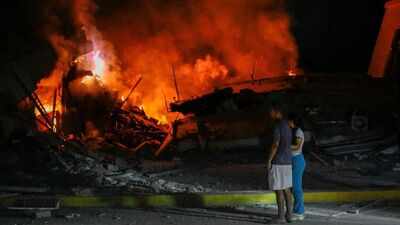
The effects of the Venezuela earthquake are a worrying reality that must be faced for the collapsing economy.
Twin earthquakes that struck northern Venezuela dealt a potentially devastating blow to an economy already on the brink, raising fears of a long-term setback to the country’s fragile recovery under its U.S.-backed interim government.The 7.2-magnitude quake was followed 39 seconds later by a 7.5-magnitude mainshock near the town of Morón in Yaracuy state, about 160 kilometers west of Caracas. The main shock is the largest earthquake to hit Venezuela since 1900.
The USGS initially projected that the earthquakes would put Venezuela’s GDP at an economic loss of between 2 and 20%, but has now revised its estimate of economic losses to between 1 and 5% of Venezuela’s GDP.
Even at the lower end, analysts warn that the real number may be much higher than the headline figures suggest.Research published by VoxEU has found that standard disaster databases systematically underestimate the impacts of earthquakes by excluding events that fall below specific humanitarian thresholds, and that per capita GDP typically remains below pre-shock trends for several years after a major earthquake, with much greater and longer-lasting losses in low- and middle-income economies, where building codes are weak, insurance coverage is scarce, and fiscal space is tight.
Venezuela specifically fits this description. The country’s economy has already shrunk by almost 80% since 2013, crippled by US-led sanctions, hyperinflation, corruption and mismanagement of the oil sector despite having the world’s largest proven oil reserves.Acting President Delcy Rodriguez, who took power after the US arrest of former President Nicolas Maduro in January, has been cautiously courting foreign oil companies and seeking relief from sanctions.
Although the United States has eased some restrictions and oil production has gradually increased, inflation remains high and ordinary citizens continue to suffer low wages.In a beleaguered economy, there is no clear way for the government to pay for collapsed buildings, a health care system that may soon collapse, and reconstruction bills, all while Caracas negotiates the basic terms of its return to the global economy.
Infrastructure damage
Oil infrastructure, Venezuela’s main source of income, appears to have been spared the worst. Most of the cities reporting severe damage do not host vital oil facilities, and in Maracaibo, near the large oil hub of Lake Maracaibo, no casualties were reported. The British company Shell said that all its employees in the country have been accounted for. However, extended power outages may impact crude oil production until power is restored.Simón Bolívar International Airport was damaged and all flights were suspended.
Power outages were reported in multiple states, and internet connectivity dropped sharply after the earthquake damaged telecommunications infrastructure.The extent of structural damage is due in part to weak construction; Many of the structures were built before Venezuela adopted modern international rules in the early 1970s, leaving them ill-equipped to withstand major tremors. As USGS geophysicist William Yeake said: “It’s not the shaking that kills people.
It’s the buildings that kill people.The disaster puts pressure on Washington, which has portrayed Venezuela as a foreign policy success. Just one day before the earthquakes, Trump told a rally in Pennsylvania that Venezuela was “doing great,” adding that the United States had “paid the cost of the war 28 times over already” by extracting oil. On Wednesday night, he posted that the United States “stands ready, willing and able to help,” but it remains to be seen how far that commitment will extend.Aftershocks remain a neighborhood risk, with the US Geological Survey estimating a 40% chance of an earthquake of magnitude 6 or greater in the same area within the next week. Research warns that the cumulative impact of repeated moderate earthquakes can rival the impact of a single catastrophic event, steadily eroding infrastructure, discouraging investment, and potentially lowering output over time.For a population already suffering from some of the worst levels of poverty in the world, these earthquakes struck at the worst possible moment.