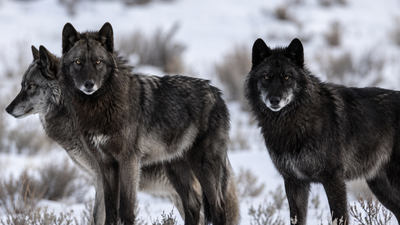
In 1995, Yellowstone National Park became the center of a conservation experiment that would later be celebrated around the world. Fourteen gray wolves have been reintroduced after an absence of about 70 years, and many ecologists credit their return with sparking a remarkable ecological recovery.
The story has become a paradigmatic example of the “food chain,” where predators indirectly reshape entire ecosystems by controlling herbivore populations. However, three decades later, science has proven to be more accurate than the popular narrative suggests. While a few researchers doubt that wolves influenced Yellowstone’s recovery, the debate is over how much of the transformation can be attributed to wolves alone.
New studies suggest that bears, cougars, human hunting, climate variability and changing herbivore populations may also have played important roles in reshaping the park’s landscape and wildlife communities.
How 14 wolves transformed Yellowstone and sparked a global conservation success story
When gray wolves disappeared from Yellowstone in the early 1900s, elk populations expanded throughout much of the park. Researchers have observed intense browsing pressure on willow, aspen, and cottonwood trees, especially along rivers and streams.
After the reintroduction of wolves in 1995 and 1996, ecologists documented declines in elk numbers and changes in elk behavior, coinciding with the recovery of important plant communities.A landmark review published in the journal Biological Conservation concluded that the return of wolves has allowed scientists to observe “a trio of populations that include wolves, elk, and plant species such as aspen, cottonwoods, and willows.”
Researchers found a decline in browsing in understory trees and evidence of vegetation recovery in parts of northern Yellowstone.Wildlife biologist Douglas Smith of the Yellowstone Wolf Project described the process as follows:“It is like kicking a pebble down a mountain slope where the conditions were just right, the falling pebble can trigger a torrent of change.”Subsequent studies have also linked wolf recovery to increases in beaver colonies, improved habitat complexity, and broader ecological benefits that extend to birds, fish, and scavengers.
New research challenges the popular Yellowstone food chain narrative
Although the Yellowstone wolf story has become one of the most cited examples in conservation, many ecologists have recently questioned whether wolves are solely responsible for the observed changes. A growing body of research suggests that ecosystem recovery reflects the combined influence of many predators and environmental factors, not just a simple chain reaction from wolf to elk to vegetation.A recent study titled “Flawed analysis invalidates claim of robust food cascade in Yellowstone after wolf reintroduction” examined decades of data on wolf, elk, and aspen communities.
The researchers concluded that the indirect effects were primarily driven by declines in elk density rather than behavioral changes caused by fear alone. The study also highlighted the importance of other predators, including cougars and grizzly bears, in impacting elk numbers.Wildlife ecologist Daniel McNulty said:“The main problem with the simple trophic succession story is that it ignores the role of these other predators.”Likewise, other scientists caution against portraying Yellowstone as an obvious environmental success story, noting that climate conditions, drought patterns, bison expansion, and human management decisions have all affected the recovery of vegetation throughout the park.
What scholars agree on today Yellowstone wolves and ecosystem restoration
Despite disagreements about the size of the effect, there remains broad scientific consensus that wolves contributed significantly to environmental changes in Yellowstone. Recent research continues to find evidence of recovery of willow and aspen trees and their associated wildlife populations after the reintroduction of wolves. Another study examining “the primacy of density-mediated indirect effects in the community of wolves, elk, and aspen” also reported strong evidence that wolf recovery reduced browsing pressure and enhanced willow growth across northern Yellowstone.Likewise, researchers defending the trophic cascade hypothesis stated in a 2024 commentary:“Recruitment of aspen seedlings increased as elk browsing decreased, following the reintroduction of wolves into Yellowstone National Park in 1995-1996.”The emerging scientific view is not that the original Yellowstone story was completely wrong, but rather that it was incomplete. Wolves appear to be an important part of a much larger ecological puzzle that includes many predators, herbivores, and ecological forces. Rather than showing how a single species can repair an ecosystem immediately, Yellowstone increasingly shows how ecological recovery emerges from complex interactions that unfold over decades.