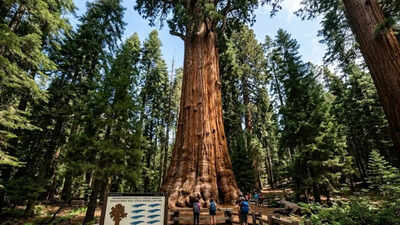
The Giant Sequoia Tree Experience is more than just an experience with nature; It is an experience of absolute impossibility. Within California’s Sierra Nevada Mountains, there is a veritable jungle full of these ancient giants that challenge our understanding of the biology and size of living organisms.
Think about the true size of the organism, which must exceed the total weight of dozens of the largest animals in the ocean. With each tree as tall and wide as an urban skyscraper, these trees have personally witnessed all of human history and lived to see the sun rise over Earth many times throughout their existence. The forest of trees is not just that; Rather, it is a sanctuary, where time is calculated by the number of rings on each tree trunk, and the weight of trees is measured in millions of pounds.
When you see all of this for yourself, you’ll start thinking about how huge these sequoia trees are as you visit the heavyweights of Sequoia National Park.
how General Sherman Tree It weighs more than 10 blue whales
The sheer size of giant sequoias, especially the General Sherman tree, possesses an unusual biological characteristic beyond that of typical terrestrial species. According to research conducted by the National Park Service, the General Sherman Tree allegedly weighs about 1,385 tons based on estimates of the volume of its trunk alone (52,500 cubic feet), while considering the weight of its roots and branches the total weight comes to about 2,100 tons.
Based on the average weights of adult blue whales (between 150 and 190 tons), a single sequoia tree can represent more than 10 to 14 adult blue whales in total mass.
Why sequoias never stop growing: The chemistry of a 3,000-year-old carbon sink
The reasons why many tree species reach their maximum size is determined by biological processes, meaning they will never be able to grow more wood. Sequoia trees continue to produce new wood throughout their lives, meaning that after reaching the maturity of the species, the sequoia also acts as a carbon storehouse at this stage, adding daily to the sequoia tree’s mass.
The reason they have been able to add to their mass every day for 3,000 years (and many are still adding to their mass annually) is because of their unique chemical composition.
Its bark consists of significant levels of a chemical called tannin. Tannins protect against insect attack (insects eat through wood) and also help reduce the possibility of burning and decay from exposure to moisture. This allows them to maintain an efficient supply of biomass over thousands of years, compared to the majority of trees, which have a very short life cycle and a very short/limited amount of biomass (compared to centuries and thousands of years of trees) to produce.
How do shallow roots support 1,500 tons
Giant sequoias weigh millions of pounds but are able to remain stable while growing in deep, shallow and expansive soil. Geological and botanical surveys conducted by the National Park Service indicate that these trees do not have a deep root; Instead, their roots typically don’t go deeper than a foot into the ground, and typically don’t reach more than 6 or 12 feet. To support the weight of a living “skyscraper,” the roots of these trees can extend 100 to 150 feet outward and usually connect to the roots of neighboring trees.
This underground system creates a combined mat of wood and soil that helps provide the necessary tension to prevent the 1,500-ton trees from tipping over.
The role of sequoia in water cycles and forest cooling
These large trees are not just a statistical anomaly but an important part of the Sierra Nevada ecosystem. Research by the U.S. Geological Survey (USGS) suggests that the high biomass density (weight of plants) in sequoia trees has a significant impact on local water cycles and forest cooling. A single mature tree can evaporate several hundred gallons of water per day, due to the enormous surface area of its leaves and the hydraulic pressure generated by the large trunk.
The microclimate affected by these trees shows how their astonishing size helps maintain the biodiversity of this entire mountain range.