These days, there is an assumption around the world that you should buy gold to invest in the future. All major investors suggest buying gold as the best way to invest money.
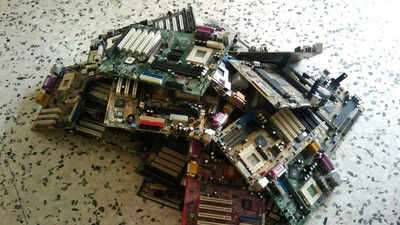
Scientists at the Swiss Federal Institute of Technology ETH Zurich have developed a sustainable method to recover 22-karat gold from electronic waste using a protein composed of whey, a byproduct of the dairy industry. Swiss researchers have successfully recovered 450 milligrams of 22-karat gold from 20 discarded computer motherboards. This particular research, conducted by scientists at ETH Zurich, has been published in the journal Advanced Materials.
How to Hide 20 Discarded Motherboards in 22 Karat Gold
According to a joint report by the United Nations Institute for Training and Research (UNITAR) and the International Telecommunication Union (ITU), the world produced a record 62 million tons of e-waste in 2022.
These scraps literally contain a gold mine. These electronic devices such as motherboards are usually expensive due to the use of gold in their connectors and circuit paths due to its superior conductivity and resistance to corrosion. Researchers at ETH Zurich confirmed in their study that by processing just 20 old computer motherboards, they could recover 450 milligrams of high-purity 22-karat gold. The number can increase if the amount of abandoned motherboards is higher.
Whey for Wealth: Using dairy byproducts to extract precious minerals
The most fascinating part of the Swiss research is the use of whey, a common liquid byproduct of cheese making. Whey proteins are traditionally considered a waste product, and scientists have turned them into a highly efficient “protein sponge” capable of recovering gold from discarded electronic scrap such as a motherboard.As reported by ETH Zurich (Swiss Federal Institute of Technology), the researchers denatured whey proteins under high temperature and acid to create tiny fibers called amyloid fibrils.
These nanometer-sized fibers were then dried to form a sponge. When this sponge is placed in a solution of dissolved computer motherboards, it acts like a molecular magnet.
Profitable and green future Electronic waste recycling
The success story of Swiss researchers with the sponge protein method signals a shift in the way we look at global waste streams. By solving the extraction theory that high-purity gold can be extracted using organic materials rather than some type of toxic chemical, researchers have laid the foundation for a truly environmentally friendly and profitable circular economy.
This study transforms electronic waste from a growing environmental liability into a profitable resource.
How the discovery of 22 carat gold is a win for the global economy
According to economic analysis provided by ETH Zurich, the value of 450 mg of 22-karat gold far exceeds the costs associated with its extraction. Furthermore, energy and raw material costs are approximately 50 times lower than the market value of the gold being mined. This profit-to-cost margin makes this technology very attractive to scale up commercially, because it allows a faster and cheaper way to extract gold from ores found deep underground.