Every year, the world generates hundreds of millions of tons of plastic waste, the vast majority of which ends up in places where it is of no use. A landmark 2025 study in the journal Nature Communications Earth & Environment, which analyzed the global trade-related flow of plastics for 2022, found that the global plastics recycling rate remained stuck at just 9 percent, with incineration now the dominant disposal method at 34 percent and landfilling at 40 percent.
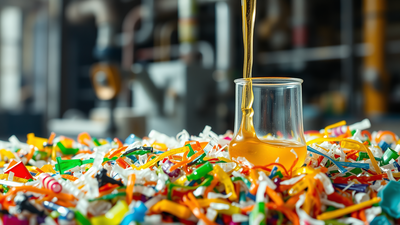
Against this backdrop, a team of researchers at the University of Amsterdam has built something that could change mathematics entirely: a 25-litre mobile experimental reactor that takes mixed, unsorted plastic waste and turns it into reusable oil in less than 30 minutes.
It is headed to Spain this summer for its first real-world test, and the results could reshape how the world deals with one of its most pressing pollution problems.
What is thermal liquefaction and how does the UvA plastic waste recycling process work
The technology at the heart of the pilot plant is called thermal liquefaction, or STL. Developed by the Catalysis Engineering Group at the Van’t Hoff Institute for Molecular Sciences at the University of Amsterdam under the supervision of Associate Professor Dr Shiju Ravindran, it works by feeding mixed plastic waste directly into a closed reactor vessel, where it is exposed to a mixture of solvents, high heat and high pressure.
The crucial innovation is a set of specially designed nanostructured solid catalysts developed by the UvA team. These microstructures accelerate the chemical decomposition of the plastic’s molecular bonds without being consumed by the reaction itself, meaning they can be reused across cycles. Within 30 minutes, the process cleanly splits the plastic feed material into three outputs: gas, which is redirected to help power the system itself; char, a solid byproduct that is filtered; And dark brown oil.A 2022 study in the Journal of Chemical Engineering on the thermal liquefaction of polyethylene-based plastics found that oil produced by the STL method has a higher heating value compared to that of gasoline, confirming the quality of the resulting energy. Most importantly, the oil also contains monomers, which are the essential molecular building blocks needed to manufacture brand new, high-quality plastics, not degraded byproducts.
Why chemical recycling of mixed plastics without sorting is a game-changer for the circular economy
The biggest bottleneck in plastic recycling globally is sorting.
Traditional mechanical recycling requires separating waste by type of plastic, polyethylene from polypropylene, PET from PVC, before processing. In practice, most municipal plastic waste is a mixed, contaminated stream that makes this separation expensive, labor-intensive, and often economically unviable. The result is that huge amounts of technically recyclable materials end up being incinerated or buried in a landfill anyway.The Special Tribunal for Lebanon avoids this entirely. The reactor accepts the mixed plastic stream as is, regardless of its composition. According to the UvA’s Van ‘t Hoff Institute for Molecular Sciences, a key feature of this process is its ability to handle all types of plastics simultaneously, making it directly suitable for complex and polluting waste streams that current infrastructure cannot handle. The process has been validated through kinetic studies, computational fluid dynamics modeling, and technical and economic analyses, all of which have supported its development from bench scale to the current experimental phase.
Plastics Project: A €20 million European plan that aims to close the plastic recycling loop
The STL technology was developed within the broader European PLASTICE project, a €20 million EU-funded research initiative focused on closing the plastics recycling loop through new conversion methods. Of this total, more than €1.5 million has been allocated specifically to Raveendran’s Catalyst Engineering group at the UvA to develop and demonstrate the STL process.The project has brought the technology to Technology Readiness Level (TRL) 6/7, an engineering milestone that indicates readiness for an operational environment rather than a controlled laboratory.
To build the actual pilot plant, the Amsterdam team partnered with an industrial engineering firm in India, where together they designed and manufactured a highly durable, transportable system complete with storage tanks, remote control software and stringent safety bypasses.
The entire installation is mounted on robotic steel frames known as sleds, making it modular and transportable, an important design choice for a technology that could eventually be deployed at decentralized waste processing sites around the world.
COGERSA waste facility in Spain: testing the pilot reactor on real municipal plastic waste
The first operational test of the pilot plant will be carried out at COGERSA, a public waste management company in Spain. This is where the technology faces its most pressing challenge, but not the controlled laboratory feeding of pre-selected plastics, but actual municipal waste streams with all the variability, pollution and compositional complexity that real-world waste brings.A 2025 study by UvA researchers, published in the Journal of Chemical Engineering, examined the use of hydrothermal liquefaction in post-consumer HDPE-rich municipal waste in collaboration with COGERSA and TotalEnergies, laying the scientific foundation for this precise operational context.
That study found that the process is capable of converting real-world municipal plastic waste into new plastic monomers, validating the feedstock assumptions that the summer experiments will now put to the test on a larger scale.“Our laboratory experiments have already included actual plastic waste, but we will certainly face challenges that we have not been able to fully anticipate,” Raveendran said. “And that is exactly the purpose of this scale-up phase to move the technology towards real industrial relevance.”
What happens to the oil produced and how STL can be transformed into industrial chemical recycling
The oil produced from the STL process is not a finished fuel product, but rather a raw material. The dark brown oil produced after each 30-minute cycle contains the fine particles needed to manufacture new, high-quality plastic that is chemically identical to plastic made from fossil fuels. This closes what researchers call the plastic loop: waste plastic goes in, and the raw material for new plastic goes out, without the quality degradation that typically occurs during traditional mechanical melting and remolding.If the Spanish trials show consistent performance on real municipal waste, the modular, skid-mounted design of the pilot plant means it can be replicated and deployed in waste treatment facilities globally without the need for large central infrastructure. The viability of this technology at TRL 6/7 also means that the path to commercial-scale industrial deployment is shorter than most early-stage recycling innovations, an important distinction in a sector where many advanced processes have historically stalled between the laboratory and the factory floor.