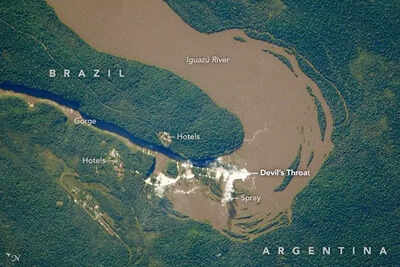
The world’s largest waterfall system in terms of width is located between Brazil and Argentina – extending 2.7 kilometers in length (Image source – NASA)
Along the border between Brazil and Argentina, the Iguazu River widens, slows, then declines. The ground simply falls. Iguazu Falls extends approximately 2.7 kilometers across a basalt plateau, forming what is generally described as the largest waterfall system in the world.
The site consists of approximately 275 individual waterfalls. Altitudes range between 60 and 90 metres, depending on the section and season. At its center is a wide semicircle known as the Devil’s Throat, where the water flows into a narrow gorge and rises again in a spray. The plume is often visible from aircraft and satellite images. On both sides of the river, national parks protect the surrounding subtropical forests. The falls have held UNESCO World Heritage status since 1984.
Iguazu Falls is the largest waterfall system in the world by width
Iguazu Falls is located on a volcanic rock formation that formed the border between Argentina and Brazil. Over time, the river’s flow cut through layers of hardened lava, creating separate steps, islands and curtains of water rather than one continuous trickle. The Iguazu River bends sharply before reaching its edge, which explains the broad, curved shape of the falls.The sections vary in character. Some waterfalls fall in thin threads.
Others sink deeply into the shaded canals below. The scale becomes more apparent from above, where the white arches contrast sharply with the deep green forest. The gorge below Devil’s Throat is narrow and steep, gradually widening as erosion continues upstream.
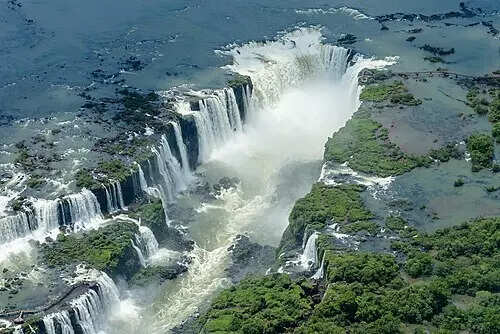
Iguazu Falls is the largest waterfall system in the world by width (Image source – Wikipedia)
Subtropical forests support rare wildlife
The surrounding rainforests form part of the protected ecosystem shared by the two countries. More than 2,000 species of vascular plants grow here. Humidity remains high most of the year, supported by constant drizzle.Typical wildlife in this area includes tapirs, giant anteaters, howler monkeys, ocelots, jaguars and caimans. Bird life is particularly active near the water. Among them is the great dusky, a dark-colored, fast-flying species known for nesting behind waterfalls. The birds fly straight across falling water to reach ledges hidden from predators. This behavior seems risky but provides protection from many threats found deep in the forest.
Tourist infrastructure surrounds the waterfalls on both banks
Both Argentina and Brazil maintain viewing areas within their national parks. Boardwalks span parts of the river, allowing visitors to get up close and personal with many of the waterfalls. On the Argentine side, a one-kilometre-long walkway passes through calm waters before reaching the edge of the Devil’s Throat.Hotels operate near the park entrances on both banks. Access routes are regulated, although visitor numbers remain high throughout the year. Early morning light often reveals the size of the spray plume rising from the valley. From certain angles, the fog casts faint shadows on the surface of the river before dissipating into the forest air.