

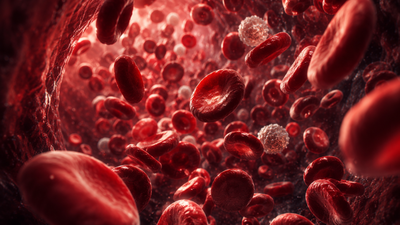
Every drop of blood in your body is doing something ancient. It carries oxygen, fights infection, clots wounds, and guards against threats, a set of tasks so basic to animal life that almost every creature with a backbone does some version of the same thing.
But where did the blood cells come from in the first place? How could a single fertilized egg, over hundreds of millions of years of evolution, produce something as complex and specialized as an immune system? Researchers at Kyoto University have now published what may be the most complete answer yet to that question, and the answer is much more modest than anyone expected. It turns out that your immune cells don’t just descend from ancient animals.
They trace their origins to single-celled organisms that lived on this planet 700 million years ago, long before complex animal life ever existed. The legacy of those microscopic ancestors is still circulating inside you, now, every time your immune system does its job.
What scientists have discovered about the origin of blood cells
The Kyoto University team has developed a new analytical method that compares gene expression patterns across many cell types and animal species simultaneously.
Gene expression, which genes are turned on or off in a particular cell at a particular time, acts like a fingerprint, revealing what the cell is doing and where it came from. By constructing evolutionary family trees from these patterns and comparing them across the entire animal kingdom, the researchers were able to trace blood cell lineages back through time with an accuracy that previous methods could not achieve.They also did something no previous study had attempted on this scale: they compared blood cell gene expression not just across animals, but with protozoans, single-celled life forms that predated fully complex animals.
How do macrophages communicate with humans? land Oldest life
Among the human blood cell lineages examined, macrophages showed the strongest similarities to unicellular organisms. This finding suggests that early blood cells may have resembled phagocytic immune cells that engulfed harmful microbes and cellular debris.Macrophages are, to some extent, the original immune cell. They work by ingesting the surrounding threats of a harmful microbe or piece of cellular debris, then ingesting and neutralizing them.
This is the same basic mechanism that single-celled organisms use to eat. A single-celled organism feeds by wrapping itself around a particle and absorbing it. Macrophages defend the body by doing much the same thing. The similarity is not a coincidence.
It’s evolutionary.The team also traced the FOS gene, which is widely expressed in blood cells in many animal species, back to a single-celled ancestor that lived about 700 million years ago.
This suggests that the first blood cells likely appeared at the same time as multicellular animals first appeared on Earth.Seven hundred million years ago, there were no fish, no insects, and no plants with roots. The most complex life on Earth was colonies of cells that first began to cooperate. The gene that passes through the blood cells of every vertebrate living today was already present in the ancestors of those single-celled colonies.
700 million year old blood cell family tree
The analysis revealed how different types of blood cells branched out over time. Mast cells appear to have evolved from macrophages, while early versions of T cells and red blood cells later emerged from mast cells. Model B cells branched directly from macrophages after mast cells had already separated.This is a remarkably tidy breed. Macrophages, ancient phagocytes, the closest living relatives of these original one-celled ancestors, are located at the root of the tree.
From it, over hundreds of millions of years, the full complexity of the modern immune system branched outward. T cells that coordinate immune responses. B cells that produce antibodies. Red blood cells that carry oxygen. The research suggests that they all descend from the same ancestral line that began with a single cell wrapping itself around something it wanted to eat.The findings suggest that early animals created the first blood cells by reusing genetic material inherited from their ancient single-celled ancestors, and that the evolutionary paths of modern blood and immune cells still reflect this 700 million-year evolutionary history.
Why this research matters for cancer and disease
The study is not just a piece of deep evolutionary history. The researchers believe their new analytical method can be applied to study the evolutionary origins of diseases, including cancer. Understanding how blood cells differentiated over 700 million years may shed light on why some developmental pathways are dysfunctional in leukemia and other blood cancers, because the pathways disrupted by cancer are the same ancient pathways the study has now mapped.Team leader Hiroshi Kawamoto said: “I am deeply moved by these results, which represent the culmination of our work and demonstrate that the differentiation pathways of vertebrate blood cells reflect the evolutionary history of these cells over 700 million years.” First author Yusuke Nagahata added: “When I realize that this legacy from long ago circulates within my body as blood cells, I feel closer to our distant ancestors.”This instinct, a sense of connection across an almost incomprehensible span of time, is perhaps the truest response to what the study reveals. The immune system you rely on to fight every infection, heal every wound, and neutralize every threat your body faces is not a modern invention. It is 700 million years old. It was already working, in its earliest form, before animals with eyes, limbs, or brains existed anywhere on Earth.