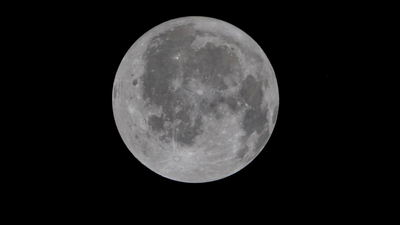
On a historic mission to the Moon, NASA’s Artemis II astronauts will study its surface using what lead scientist Kelsey Young calls “the best camera that can or will ever exist” — with their own eyes.
As of early Sunday, the crew of four, three Americans, Commander Reed Wiseman, Pilot Victor Glover, Mission Specialist Christina Koch, and Canadian astronaut Jeremy Hansen, had passed the “two-thirds” mark of their journey aboard the Orion spacecraft. They are expected to reach the moon on Monday and fly by and take pictures of the far side of the moon during the mission. “The human eye is basically the best camera that can or will ever exist,” Kelsey Young, Artemis II’s chief scientist, told AFP.
“The number of receptors in the human eye far exceeds what a camera can do.”Despite advances in imaging technology, Young noted that human vision excels at detecting color, context and subtle changes in illumination that reveal textures on the moon’s surface. “Humans can understand how lighting changes surface details, such as how angular lighting reveals texture but reduces visible color,” she added.The crew underwent more than two years of rigorous training to become “field scientists,” including geological missions to Iceland and Canada, simulated lunar flybys, and memorized “Big 15” lunar features.
Using an inflatable lunar ball, the astronauts practiced observing how sunlight changes the colors and textures of the surface, honing their skills for taking detailed notes.Noah Petro, head of NASA’s Planetary Geology Laboratory, said the moon will appear “the size of a basketball at arm’s length” to astronauts. “The question that interests me most is: Will they be able to see colors on the moon’s surface,” he said, referring to the light brown color that indicates composition and history.David Kring of the Lunar and Planetary Institute has tempered his expectations for major discoveries, but emphasized the historic nature of the observations. “Having astronauts describe what they see…is something that at least two generations of people on Earth have never heard of,” he said.Artemis II was launched from Kennedy Space Center’s Launch Complex 39B atop a NASA Space Launch System rocket on April 1. The mission, the first manned flight to the Moon in more than 53 years, advances NASA’s Artemis program, which aims for sustainable lunar exploration and eventual human missions to Mars.