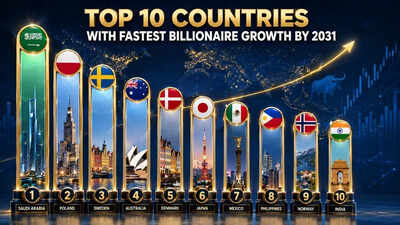
The next few years are expected to redraw parts of the global wealth map in ways that do not always match familiar economic narratives. Some of the fastest billionaire movements are expected to occur outside the usual Western centres, with shifts linked to capital flows, policy changes, technological expansion, and regional investment cycles.
A few countries saw unusually sharp jumps in percentages rather than steady growth, suggesting concentrated explosions in wealth creation rather than slow accumulation. The pattern is not uniform, and does not follow a single model of development. Instead, it looks like sporadic accelerations across Asia, Europe, and the Middle East, driven by different local drivers and timing influences.As reported by World of Statistics (formerly
Countries with the fastest rising billionaires by 2031
| Rank | nation | Expected growth |
| 1 | Kingdom of Saudi Arabia | 183% |
| 2 | Poland | 123% |
| 3 | Sweden | 81% |
| 4 | Australia | 77% |
| 5 | Denmark | 75% |
| 6 | Japan | 65% |
| 7 | Mexico | 63% |
| 8 | Filipino | 63% |
| 9 | Norway | 53% |
| 10 | India | 51% |
Countries with the highest expected billionaire growth rates
Kingdom of Saudi Arabia
Saudi Arabia stands out by far exceeding the rest of the list. This shift is often linked to ongoing economic diversification, as oil-related wealth is increasingly directed into new sectors such as logistics, tourism, and large-scale infrastructure. Private capital is moving into areas that did not previously attract this level of interest.What makes the shape unusual is not just the size, but the speed involved.
It indicates a relatively compact base of high-net-worth individuals that is expanding rapidly rather than gradually spreading widely.
Poland
Poland ranks unexpectedly high, driven by a combination of manufacturing strength, technology outsourcing, and deeper integration with European supply chains. Wealth creation here appears to be less linked to older industries and more to newer business structures, which are often medium-sized companies expanding into global markets.There is also a sense of timing. Capital that once flowed westward within Europe began to spread more locally, allowing local entrepreneurs to retain larger stakes in growing companies.
Sweden
Sweden shows steady acceleration rather than sharp turbulence. Much of its billionaire growth is linked to technology, green industry and export-heavy industrial clusters that have long operated internationally.The pattern here is less about sudden emergence and more about established companies continuing to compound value in more subtle ways. Ownership structures are also important, as long-standing family or founder stakes gain value over time.
Australia
Australia reflects a mix that is becoming increasingly evident: traditional resource wealth coupled with a growing technology sector. Mining-related wealth still plays a role, but new wealth pools are forming around fintech, biotechnology and digital platforms.The growth rate indicates a system in which capital circulates between old and new sectors without completely replacing either. This overlap seems to do a lot of work.
Denmark
Denmark does not usually feature loudly in discussions of global wealth, but the expected increase indicates a strong performance in specialized industrial design, pharmaceuticals, and renewable energy-related companies.It is a relatively small economy, and percentage movements can be exaggerated, but the underlying companies tend to be globally embedded rather than local.
Japan
Japan shows a more conservative rise compared to emerging markets, but it is still notable given its already well-established wealth base. This shift is often associated with corporate restructuring, a renewed focus on shareholders, and the effects of gradual reopening in parts of its economy.Wealth creation here tends to move through large corporate ecosystems rather than fast-moving startup cycles.
Mexico
Mexico reflects a combination of expanding industrialization, particularly linked to nearby transportation trends, and long-standing industrial families that are expanding their reach.
Proximity to US supply chains has changed investment patterns in subtle but persistent ways.Growth is not evenly distributed, with some regions and sectors advancing while others remain flat.
Filipino
The Philippines continues to benefit from service-based expansion, including outsourcing, remittance-related consumption, and a slowly expanding digital economy.Wealth accumulation here is often linked to service networks rather than heavy industry, giving it a different rhythm compared to resource-led economies.
Norway
Norway is experiencing more modest growth, shaped by energy-related capital and sovereign wealth influences. Although it is not explosive, it remains stable, with wealth often concentrated in long-term holdings rather than fast-trading sectors.
India
India rounds out the list with a smaller increase than some of its peers, despite a much larger base of entrepreneurs and family wealth. Technology services, digital platforms, and the expansion of manufacturing are contributing to this movement.Growth appears to be distributed rather than concentrated, which makes percentage shifts appear more measured even when the absolute numbers are large.