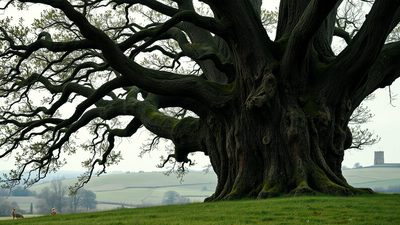
A Rutland oak tree, which was hit by a Lancaster bomber in World War II, has been shortlisted for this year’s UK Tree of the Year award, along with nine other trees chosen to survive extraordinary events across centuries of British history.
The Woodland Trust, the charity behind the annual competition, has built this year’s theme around the idea of facing the odds, celebrating rare, ancient or endangered trees that have withstood everything from plane crashes to artillery shells. Members of the public can now vote for their favorite trees from among the shortlisted trees, with the winner set to be announced later this year.
how Bomber Oak He earned his place on the shortlist
According to the Woodland Trust’s official announcement of this year’s shortlist, the 180-year-old oak tree stands on a family farm in Rutland and still bears visible signs of its wartime encounter, including a slight depression in its canopy and its central branches twisted and misshapen.
On 26 April 1945, a Lancaster bomber returning prisoners of war from Germany to England struck the top of a tree, snapping it off, before the plane could fly a few more miles and crashed, killing all but two of the seven men on board.
The tree recovered from the impact, and decades later survived a second threat when a water company planning to install pipes across the field was successfully opposed by local protestors, including from the family that had owned the farm for generations.
A yew that survived a Civil War cannonball
Other candidates include the Crowhurst Yew tree in East Sussex, which is thought to be up to 4,000 years old and is famous for having survived a direct cannonball hit during the English Civil War in the 17th century. According to the Woodland Trust, villagers discovered the cannonball embedded in a trunk in 1820 while hollowing out the tree to create a parish meeting room complete with a door, tables and chairs. The roof of the improvised room later collapsed during a violent storm in 1845, however the tree survived that too and still stands today in St George’s churchyard in Crowhurst.
Trees that braved the cliffs, church towers and lightning
The shortlist also includes a downy birch tree clinging to the edge of a cliff in County Durham and a yew tree that grew at the top of a church tower overlooking the Devon village of Colmstock almost two hundred years ago. In Dumfries and Galloway, the Earlston Lightning Oak earned its status after surviving a direct lightning strike, while the Preston Twin in Brighton, probably the oldest English elm in the world, survived for four centuries despite Dutch elm disease, a fungal infection that killed a similar-aged elm that stood nearby.
Welsh oak and generic wildcard entry
In addition to the eight trees selected by a panel of experts, two additional entries were selected directly through public nomination as wildcard selections. According to Nation Channel coverage. Cymru, one of which is the Wales Coast Path Oak in Ceredigion’s Ynys hir Nature Reserve, which has withstood storms, drought and livestock grazing while providing shade and shelter for walkers along the long-distance coastal path. Another general allowance is the ashes of Balloch Castle, which lie on the grass of the nearly deserted Balloch Castle beside Loch Lomond.
Why the Woodland Trust runs this competition every year
May Shamis, who manages the Woodland Trust’s ancient tree inventory, said the shortlist shows how strong and resilient trees can be, noting that species such as the yew are able to restructure themselves internally in order to continue living. Actor and nature presenter David Oakes, a Woodland Trust ambassador, added that while most living things escape danger by running away, a tree permanently rooted in one place has no such option, and has instead mastered the art of overcoming whatever comes its way.
How can the public participate in choosing the winner?
Voting for this year’s Tree of the Year is open to the public via the Woodland Trust website and remains open until late September, with the winning tree announced in early autumn. The competition has been running in the UK since the Woodland Trust began coordinating national entries in 2014, with the winning trees subsequently entered into the wider European Tree of the Year competition. Each tree shortlisted in this year’s competition carries its own distinct story of survival, offering a reminder that some of the country’s most iconic natural landmarks are also its most resilient and resilient.