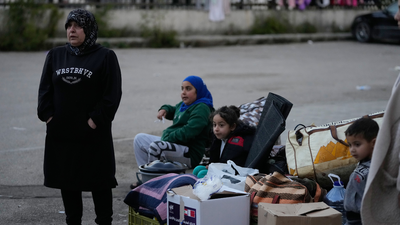
Ceasefire in name only? Gulf countries sound sirens (AP Photo)
Missile sirens sounded in several Middle Eastern countries early Wednesday, despite Iran and the United States announcing they had reached a two-week ceasefire in the war. Despite diplomatic efforts, fighting appears to be continuing across multiple fronts.
In Abu Dhabi, officials said a gas processing facility caught fire following the upcoming Iranian strikes. It was not immediately clear what targets were struck in Israel, which has faced rocket and drone attacks throughout the conflict.Alerts were also reported in Saudi Arabia, Bahrain and Kuwait, highlighting the confusion and instability surrounding the ceasefire.Iran’s paramilitary Revolutionary Guard has taken over much of the war, with field commanders reportedly making decisions on strikes independently, raising doubts about whether all forces are adhering to the ceasefire.Observers point out that in many conflicts in the Middle East, last-minute attacks are often carried out before the truce takes full effect, allowing the parties to claim an advantage.The goal of the ceasefire, which includes Iran, the United States and Israel, was to stop the war that has destabilized the region and disrupted global energy markets. However, questions soon arose about its terms and implementation.Iran insists it will retain control of the Strait of Hormuz and continue uranium enrichment, two major sticking points for Washington.
US President Donald Trump initially described Iran’s proposal as “practical” before later describing it as “fraudulent”, while stressing that ending Iran’s nuclear program remains a key goal.Israel supported the ceasefire but made clear that it did not apply to its ongoing conflict with Hezbollah in Lebanon. Pakistan, which acted as mediator, said the truce took effect immediately and that further talks could begin soon in Islamabad, a claim contradicted by the continuing strikes.In Tehran, pro-government demonstrators took to the streets after the announcement, chanting against the United States and Israel and rejecting any settlement.Under the proposed terms, Iran would allow passage through the Strait of Hormuz under military supervision and, along with Oman, would likely impose transit fees on shipping. Tehran also demanded the withdrawal of US forces from the region, relief from sanctions, and access to frozen assets.Even when the United States halted its offensive operations, Iran and Israel appeared to continue military action. Recent strikes have targeted infrastructure, including oil facilities and transportation networks, exacerbating economic and geopolitical tensions.As casualties rise in Iran, Israel, Lebanon and the wider region, and missile warnings continue, the ceasefire remains fragile and its future uncertain.