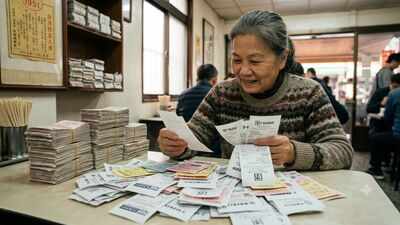
For most people, a shopping receipt is something that quickly disappears in a wallet, pocket, or trash can. In Taiwan, this small strip of paper has a completely different role. A routine purchase at the supermarket, café or clothing store can also become an entry into the National Lottery, with receipts holding the potential to win thousands of dollars.
The idea sounds simple, but behind it is a carefully designed tax system that uses consumer behavior to improve compliance. By giving shoppers a personal reason to demand receipts, Taiwan has created a way for ordinary purchases to become part of the government’s efforts to track business activity and limit hidden transactions.The Department of Finance states that consolidated bill award numbers are drawn for each two-month billing period.
The rules specify that winning numbers will be drawn on the 25th of each odd-numbered month (January, March, May, July, September and November), meaning six drawings per year. According to the Laws and Regulations Retrieval System of the Ministry of Finance, Taiwan has moved towards electronic invoices, including for digital telecommunications companies and mobile phone services.
Consumers can store bills electronically and verify winnings digitally.
How to turn a simple shopping receipt from Taiwan into a big profit opportunity
A visitor shopping in Taiwan may notice an unusual custom at the checkout counter. Unlike many countries where receipts are quickly discarded, shoppers in Taiwan often keep them because each official invoice carries the potential to win a cash prize. In many countries, receipt rejection is common.The identification number printed on standard invoices in Taiwan is not just a transaction record. It could also become a lottery entry, giving consumers a reason to keep receipts they might otherwise throw away.The system has been in existence for more than seven decades and is still active today. Taiwan’s Ministry of Finance holds six voucher lotteries each year, where consumers can win prizes ranging from small amounts to a grand prize of NT$10 million. The system has been in existence for more than seven decades. It was introduced in 1951 as a way to address a problem faced by many governments: businesses failing to report their full sales and underpaying taxes.
The tax problem in Taiwan has been solved by changing customer behavior
The challenge with indirect taxes is that governments often rely on businesses to accurately record transactions. When sales are made without receipts, authorities have a limited view of the true level of economic activity. A store that does not advertise the sale can reduce the amount of tax it owes. Monitoring each individual transaction would require enormous resources, making implementation difficult.The Taiwanese approach has changed the relationship between customers and companies.
Instead of relying solely on government inspections, it gave consumers a reason to request proof of purchase.If customers want a chance to win, they need a receipt. If they ask for a receipt, businesses are more likely to record the sale correctly. The simple rewards system created a financial incentive for shoppers to help ensure transactions were entered into official records.
Why is tax evasion so difficult to solve?
Tax evasion is not limited to Taiwan. Governments around the world have long struggled to bridge the gap between actual economic activity and what is reported to tax authorities.Traditional methods typically include audits, sanctions, and inspections. These tools can work, but they are expensive and often reach only a small fraction of companies. Tax authorities may never learn of transactions that are intentionally kept outside official records.Economists have studied tax compliance for decades, examining how enforcement, penalties, income levels, and social expectations affect whether people and businesses follow tax rules.A recurring problem is the information imbalance between taxpayers and governments. Companies generally know more about their sales than the tax authorities do. The Receipt Lottery attempts to reduce this gap by making consumers part of the reporting process.Instead of just asking: “How can the government catch hidden sales?” The system asks a different question: “How can customers be encouraged to make covert sales more difficult?”
How Taiwan brought lottery receipts into the digital age
Although the original system was based on paper receipts, Taiwan has gradually moved towards digital versions.Many shoppers no longer need to keep stacks of receipts at home. They can link purchases to a digital account, scan a barcode before paying or receive notifications through mobile services if their receipt number wins. This transformation has helped reduce paper waste while keeping the basic idea intact. The bonus remains the same: consumers have a reason to ensure that transactions are officially recorded.For many residents, checking winning numbers has become a normal part of daily life.
Some people only get small rewards, while others continue to hope that a routine purchase will eventually lead to a much larger reward.Receipts can also be donated to approved charities. In those cases, organizations can claim any prize money associated with donated entries.
Tax experience that has spread beyond Taiwan
Taiwan’s model attracted the interest of other countries that were looking for ways to improve tax collection.As the Australian Broadcasting Corporation (ABC) has reported, several governments have introduced similar receipt lottery programs, including Brazil, Portugal, the Czech Republic, Lithuania, Romania and Slovakia.
Mainland China has also experimented with lottery receipts in different regions after seeing Taiwan’s experience.China’s adoption of this idea was linked to concerns about unreported economic activity and difficulties in capturing precise business transactions. Research on these programs suggests that encouraging consumers to request official receipts can increase tax reporting.This approach does not eliminate tax evasion, but it provides a different method of implementation. Instead of relying solely on government monitoring, they use incentives to change everyday behavior.