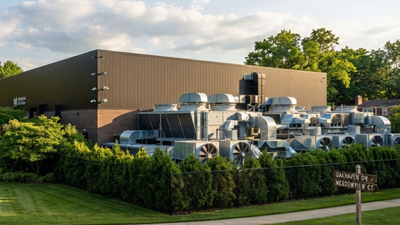
What was once a quiet neighborhood in southwest Michigan has become a source of constant frustration for a couple who lives next door to a large data center. Marjorie and Billy Finn say the facility’s relentless noise now dominates their daily lives, making it difficult for them to relax outdoors, sleep at night, or even enjoy conversations in their home.
Comparing the experience to “living in prison”, they claim the sound has alienated friends and family, reduced their quality of life and left them feeling trapped in the house they have called home for years.
A Michigan couple says life changed after the data center arrived
The dispute centers around a 30-megawatt high-speed data facility in Dowagiac, a small city in southwest Michigan. The data center began operating in 2022 after acquiring a former industrial site, bringing with it rows of servers that require powerful cooling systems to operate around the clock.The Finns, whose home is directly across the road from the complex, say the constant buzzing began shortly after the facility was put into operation. According to the couple, what was once a quiet neighborhood has become dominated by industrial noise that never goes away.Billy Finn spent years documenting sound using a portable decibel meter. He says noise levels outside his home have risen from about 52 decibels when the facility first opened to about 60-61 decibels today, with occasional readings reaching 78 decibels.
Inside the home, the sound is less noticeable, but the moment doors or windows are opened, the constant hum becomes impossible to ignore. Billy likened it to standing near a busy city street or hearing an airliner flying in the distance, except that the noise continues day and night without interruption.Marjorie Finn says the constant background sound affected her sleep and made spending time in the garden much less enjoyable.
She also claims that fewer friends and relatives are visiting now because of the noise.
Why do data centers make so much noise?
Although many people envision servers as the loudest part of a data center, the biggest source of noise is usually the cooling infrastructure. Modern data centers contain thousands of computers that generate massive amounts of heat, requiring industrial-scale fans, chillers, and cooling towers to operate continuously.The rapid growth of artificial intelligence has exacerbated the problem.
AI systems rely on densely populated, high-performance computer chips, which consume more electricity and generate more heat than traditional servers. As a result, newer facilities often require larger cooling systems capable of running all day and night.
Residents say the issue goes beyond noise
Finns are not the only population raising concerns. Other homeowners living near the facility filed a lawsuit, claiming that the persistent sound amounted to an unreasonable nuisance and diminished their ability to enjoy their property.
The lawsuit also alleges that the operator failed to install adequate sound barriers or other noise reduction measures.The Finns chose not to join the legal action, but they share many of the same concerns. They worry that the constant noise has reduced the value of their home while making daily life increasingly stressful.
Can constant environmental noise affect health?
While noise levels of around 60 decibels are generally not high enough to damage hearing, health experts say long-term exposure to persistent environmental noise may have consequences.
Research has linked constant background noise to disturbed sleep, higher stress levels, decreased concentration, and, over long periods, an increased risk of cardiovascular problems in some people.Audiologists also point out that constant mechanical sounds can seem particularly intrusive because they lack the natural variety found in everyday environmental noise, making them more difficult for many people to ignore.
An increasing challenge in the age of artificial intelligence
As demand for artificial intelligence, cloud computing and digital services continues to grow, hundreds of new data centers are being planned across the United States and other countries. While these facilities play a vital role in supporting modern technology, they are also attracting renewed attention to issues such as electricity consumption, water use and environmental noise.Communities are increasingly demanding stricter planning rules, greater neighborhood setbacks and improved sound insulation to reduce the impact on neighboring homes.