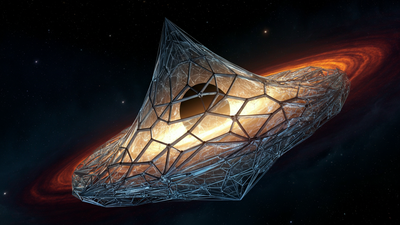
Most people imagine a black hole forming in the same way: a massive star that runs out of fuel, collapses under its own gravity, and disappears behind the event horizon. But Einstein’s theory of general relativity has always allowed for something strange.
Under certain conditions, spacetime itself, without a star at all, can arrange into a precise, ordered structure that is on the verge of collapse. Physicists call this a space-time crystal. Now, for the first time, researchers from Goethe University Frankfurt and TU Wien have deduced an exact mathematical formula that explains how this happens and what causes it to become a black hole.
What is a space-time crystal and how does it form near a black hole?
The name sounds like something out of science fiction, but the concept has been around within general relativity for decades.
When matter or energy distorts space-time, it usually does so in a chaotic and irregular way. But under very specific conditions, these distortions can organize themselves into a repeating pattern, an organized structure that physicists have called a space-time crystal.It is, as Professor Daniel Grumiller from TU Wien described it, like water at exactly 0°C. Any small change in either direction leads to a completely different result.
The space-time crystal lies at exactly this kind of threshold. If left alone, they dissolve back into ordinary spacetime. Add even a small amount of energy, and it collapses to form a black hole.This threshold behavior is what physicists call critical collapse, and it’s at the heart of the new study published in Physical Review Letters.
how Einstein’s theory of relativity Allows Black holes To form without the star collapsing
Most of the black holes discovered so far by observatories like LIGO have a mass several times greater than the mass of the Sun, and are the natural products of star collapse.
But general relativity doesn’t need a star. It just requires the correct arrangement of the curvature of space-time.“We say that spacetime is curved by mass,” explains Christian Ecker of the Institute for Theoretical Physics at Goethe University in Frankfurt. “Large objects like stars strongly bend spacetime. But smaller masses also produce spacetime curvature, but to a lesser extent.” The question raised by the new research is what happens when this curvature reaches a critical threshold, not because of the collapse of a star but because of the organization of space-time itself in the crystalline state.The answer is a black hole, likely much smaller than any black hole formed as a result of collapsing stars, perhaps smaller than an atom.
The 30-year-old computer simulation is what started the research
The story behind this breakthrough goes back to 1993, when computer simulations first revealed something unexpected. No matter how researchers set up the initial conditions near the critical threshold, black hole formation appears to follow precise mathematical rules. Behavior near the tipping point was not random.
It had structure.This result indicated the necessity of an accurate analytical formulation, which can describe the process from first principles and not through simulation alone. But despite three decades of efforts, no one has been able to achieve this. Mathematics continued to resist.
Why did physicists solve this problem using infinite dimensions?
The approach the team used to get there in the end is counterintuitive. Instead of working in the four dimensions of our universe, three dimensions of space and one of time, they increased the number of dimensions until it approached infinity.“In principle, nothing prevents us from writing physical equations for a larger number of dimensions,” Ecker says. “Five dimensions, forty-two dimensions, or even an infinite number.” The reason this helps is that some features of gravity simplify dramatically as the number of dimensions increases. Relationships hidden and entangled in four-dimensional space-time become visible and tractable in the higher dimensional boundaries.Once the team has solved the problem there, they can work backwards, using the solution as a basis for understanding what is happening in the four dimensions. “Our technology turns out to be remarkably stable,” says Florian Ecker from TU Wien. “Depending on the accuracy required, we can systematically improve our formulas using additional approximation methods.”
What does penetrating a space-time crystalline black hole mean for physics?
The practical implications extend in two directions. The first is theoretical.
Critical collapse has been one of the open problems in gravitational physics precisely because it lies at the boundary between two very different systems, ordinary spacetime and black hole formation. Having an exact formula rather than a simulation result gives physicists a new tool to understand the structure of those boundaries in detail.The second trend is surveillance. Small black holes, sometimes called primordial black holes, have long been proposed as candidates for dark matter, the invisible mass that makes up about 85% of the universe.
A precise understanding of how microscopic black holes form and what conditions are required is directly related to the search for them. As LIGO and its successor observatories like Cosmic Explorer become more sensitive, the theoretical foundation laid by this research will be important for interpreting what these instruments discover.The space-time crystal itself may not be observed directly. It exists only for a moment, at the precise threshold between something and nothing, before it turns in one direction or another. But the mathematics that describe it is now, for the first time, precise, and in physics it is the difference between knowing something exists and being able to pinpoint its cause.