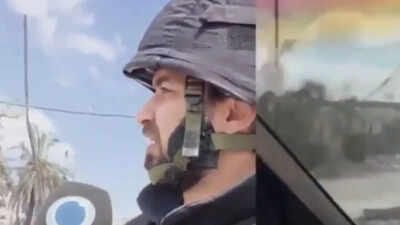
A Lebanese journalist, while covering the ground, was attacked by Israeli drones, resulting in his injury.Hadi Hoteit, who works for Press TV, said in a post on Channel X that he was beaten while filming in an open area, despite clearly showing a press ID card.
He was injured by six shrapnel when a drone fell near him while he was covering Israeli attacks in the town of Kafr Tibnit in southern Lebanon.
He wrote: “Israeli drones targeted me while I was clearly filming a report in an open place with all the requirements (press banners on the car, vest and helmet with press banners, cell phones turned on and nothing else done.”)He added that he moved to the area after being informed that the Lebanese army was blocking the road.
He said: “I stopped at the Arnoun-Yahmar-Kfarbnit roundabout because I did not want to go any further.”Hoteit said he got out of his car with his equipment and was filming when the attack occurred. “I got out of my car, my camera was in the cage and my microphone had the PressTV logo on it. I was filming when the Israeli drones deliberately attacked the place where I was standing,” he said, claiming that he was rescued by “two brave men” about 15 to 20 minutes later.
“I was trying to get away from my car because I was anticipating that they might re-target it. 6 shrapnel hit my body (1 in my right chest, 3 in my right leg, 2 in my left leg). I am better now,” he wrote, adding that he was receiving treatment in hospital.Press TV also shared footage on X showing the moment the journalist was injured, saying: “Moment Press TV journalist @Hadi Hut was attacked by an Israeli drone strike in southern Lebanon.” Hadi appears in the video wearing a press jacket and carrying a microphone and hand-held camera, and he was filming at the site when the incident occurred.Read also: Iran insists that Lebanon is the key to ending the war as Israel and Hezbollah exchange fire: Is the US peace deal already under pressure?The incident came amid the peace deal between the United States and Iran, which was announced on Monday, although Israeli officials have indicated opposition to withdrawal timelines linked to diplomatic efforts. Israeli media quoted Israeli Defense Minister Israel Katz as saying that the army will maintain its positions in regional security areas.Katz said in a statement: “Prime Minister Benjamin Netanyahu and I are leading a clear policy specifying that the Israeli army will remain in the security zones in Lebanon, Syria and Gaza, without any time limit, to protect the Israeli borders and communities from there against jihadist elements.”