

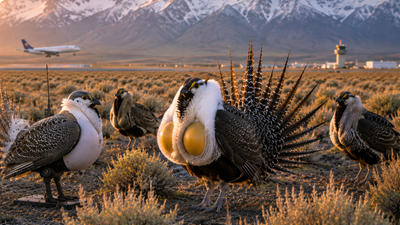
Grand Teton National Park in Wyoming has turned to an unusual conservation strategy to save one of the fastest declining bird groups: macaws. Park officials and wildlife experts have deployed lifelike robots that mimic the species’ elaborate courtship dances, puff out their chests and broadcast recorded mating calls in an attempt to lure real birds to restored breeding grounds.
The initiative aims to keep sage grouse away from nearby Jackson Hole Airport, where decades of habitat degradation and aircraft activity have contributed to a significant decline in their numbers. By recreating the sights and sounds of an active breeding site, conservationists hope the innovative decoys will encourage mating and gradually rebuild the park’s seriously declining local population.
Why does Grand Teton use robotic birds?
The greater grouse (Centrocercus urophasianus) has seen a sharp decline across much of the western United States over the past century.
While this species is not federally listed as endangered, their local numbers in Grand Teton National Park have reached alarmingly low levels. At one of the park’s breeding areas, known as a lek, wildlife officials recorded just three male sage grouse showing during the 2025 breeding season.
Conservationists believe attracting birds to the newly restored breeding site could help reverse the decline before the local population disappears completely.
Habitat loss and airport activity have led to this decline
The decline in bird numbers is linked to years of habitat degradation and increased human activity. Historically, livestock grazing has damaged the local sagebrush ecosystem that sage-grouse depend on for food, nesting, and protection from predators. Although grazing ended decades ago, the landscape has been slow to recover.Nearby Jackson Hole Airport, the only commercial airport located within a US national park, added additional pressure.
Aircraft movements disturb breeding birds during the critical mating season, while bird strikes have killed many grouse over the years. Conservationists hope that moving breeding activity away from the airport will improve the birds’ chances of survival.
How does Robotic Sage work?
The robotic traps were designed by RoboBroncs, the robotics team at Jackson Hole High School, in partnership with Grand Teton National Park and the Wyoming Game and Fish Department.
The models were designed using recycled materials such as packing foam, fabric and blankets, and were fitted with real tail feathers to make them more convincing.Some robots remain stationary, while others mimic the males’ display movements by twirling, spreading their tails, and inflating chest pouches. Loudspeakers hidden nearby record sage grouse mating calls from about 5 a.m., when the birds naturally begin their courtship displays.
Moving decoys and sounds are designed together to make the restored habitat feel like an active breeding ground.
What is a lec and why does it matter?
The lek is a traditional breeding site where male sage grouse gather each spring to compete for females. They perform elaborate courtship rituals by fanning their pointed tails, inflating bright yellow air sacs on their chests and making distinctive popping sounds. Females visit these sites to choose mates before nesting nearby.Because sage grouse often return to the same lek year after year, establishing a successful breeding ground is essential to rebuilding the local population. Conservationists hope the automated displays will convince the birds to adopt the restored site and eventually make it a permanent breeding site.
Restoring habitat is only half the challenge
Over the past eight years, park staff, community organizations and volunteers have restored nearly 100 acres of habitat near the airport.
Native sagebrush and other plants have been replanted, invasive plants removed and breeding areas carefully managed to provide ideal conditions for sagebrush.However, experts say restoring suitable habitat alone does not guarantee the birds’ return. Wildlife often relies on social cues to determine if an area is safe and suitable for breeding. Robotic decoys aim to provide those missing signals by mimicking an already active lek.
Scientists will monitor whether the experiment is successful
The project remains an ongoing conservation experiment, with surveillance cameras and field surveys tracking the birds’ activity throughout the breeding season, which typically lasts until mid-May. Researchers will look for signs that wild grouse are beginning to display, mate and nest at the restored site.If successful, the project could provide a blueprint for combining habitat restoration and robotics to support vulnerable wildlife populations. While the outcome remains uncertain, this effort highlights how technology, community partnerships and conservation science can come together to address one of the greatest challenges facing wildlife in the American West.