

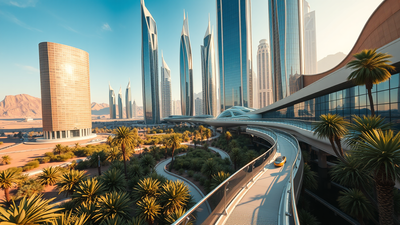
In 2017, Saudi Arabia announced something that seemed too big to be true: an entire new region along the Red Sea coast, larger than Belgium, built from scratch around clean energy, no cars, and an entirely new way of living.
The most famous project called NEOM was The Line, a car-free city meant to stretch 170 kilometers across the desert inside two towers of mirrors, housing up to nine million people who would never need a road, a car or a single exhaust pipe. Nearly a decade later, the story has taken a completely different turn. Costs rose, timelines were delayed, and by late 2025, construction on The Line had been suspended, forcing Saudi Arabia to rethink how much of this ecoregion could realistically be built.
What is NEOM and how big is the area?
NEOM is the name of the entire development area, which extends over an area of approximately 26,500 square kilometers in the northwestern Tabuk Governorate, extending along the Red Sea and the Gulf of Aqaba. According to NEOM’s official newsroom, the project is at the heart of Saudi Arabia’s Vision 2030 plan to reduce the country’s dependence on oil by building new industries and tourist destinations. Within this larger area are several distinct developments, including The Line, the floating industrial coastal city of Oxagon, the mountain resort of Trogena, the luxury island of Sindala, and a coastal tourism cluster called Magna.
The original plan for an eco-friendly, car-free city
Designed as the project’s most daring experiment, The Line is a linear city built within two parallel buildings, each approximately 500 meters high and 200 meters wide, extending 170 kilometers from the Red Sea coast toward the inland mountains. The idea was to completely eliminate roads and cars, and run the city solely on renewable energy while keeping all basic services within a five-minute walk of residents. The goal of the high-speed rail line was to connect one end of the city to the other in just 20 minutes, allowing people to move across the entire settlement without needing a private car.
Why was the font size reduced so dramatically?
This original vision ran into a serious problem. According to reports from AGBI, a business publication covering the Bay Area, NEOM has been quietly overhauling its public messaging around The Line, replacing previous promises to house nine million people and operate it entirely without roads or cars with more cautious language about a phased, demand-based approach.
With only about 2.4 kilometers of foundation work completed, the target population for this initial phase has reportedly been reduced from 1.5 million residents to less than 300,000.
What is actually being built in NEOM now
Despite The Line’s setbacks, other parts of NEOM are still moving forward. Sandala Resort, a luxury island resort in the Red Sea, has already opened to guests, although it ran into operational problems after wind and wave conditions were not properly considered during planning.
Work also continues on Oxagon, an industrial port area that has become more strategically important given regional shipping disruptions, along with a green hydrogen plant that is said to be nearing completion.
In addition, NEOM has signed agreements to build large-scale data centers within the region, redirecting some of its ambition towards digital infrastructure rather than future urban housing.
Why did the project encounter financial and engineering problems?
A combination of factors led to this downsizing, including falling oil prices that put pressure on government revenues, the enormous engineering complexity of building a mirror structure of this size across desert and mountainous terrain, and the practical challenge of attracting large populations to live within a single linear block far from any existing city.
Saudi officials have publicly framed these changes as strategic flexibility rather than failure, with the Saudi finance minister saying there is no problem slowing some projects so the broader economy can grow alongside them.
What comes next for Saudi Arabia’s ecoregion?
The Saudi Public Investment Fund, which owns and finances NEOM, noted that the broader Vision 2030 program remains intact even as its futuristic masterpiece is rebuilt around more modest projections.
Even a small initial section of the line is now expected to be completed sometime in the 2030s, with the full 170-kilometre vision pushed much further or perhaps abandoned altogether in its original form.
Whether NEOM ultimately succeeds in fulfilling its founding promise of creating a car- and carbon-free zone beside the Red Sea, or settles into a smaller collection of ports, resorts and data centres, its story so far is a stark example of how ambitious a modern green city can look on paper, and how difficult it is to build one from scratch.