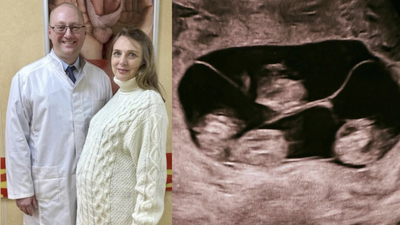
A woman in Russia gives birth to four identical girls/Photo: RT
A rare and medically significant birth has been reported in St. Petersburg, where a woman gave birth to four identical girls, the first case of its kind to be officially recorded in Russia.The birth, which took place in the city’s maternity hospital, attracted attention because of its extreme rarity. Medical estimates indicate that monochorionic twins, or identical quadruplets, occur in about one in every 15.5 million births. Globally, only about 15 such cases have been documented.All four babies were born at 32 weeks gestation and are in stable condition. Their birth weights ranged between 1,360 grams and 1,640 grams, and their lengths ranged between 37 cm and 41 cm.
Doctors described these numbers as strong for children born at this stage.In a statement shared by the hospital on Russian social media platform VKontakte, the team said: “Four charming sisters were born at 32 weeks. According to estimates, monochorionic (identical) quadruplets occur once in 15.5 million births. Such unique births have not been reported in the country.”What makes the case particularly complex is that all four babies developed from a single fertilized egg and shared a single placenta, a condition known as monochorionic pregnancy.
In most multiple pregnancies, each baby has a separate placenta. Doctors point out that such cases carry higher risks and require constant monitoring.“For a 32-week pregnancy, this is an excellent result, which was made possible thanks to the proper management of the mother in the antenatal department and the expertise of the doctors,” the hospital added.The birth required the coordinated effort of a large medical team, including obstetricians, anesthesiologists, intensivists, midwives, and neonatologists.
Each baby was cared for immediately by neonatologists and specialized nurses to ensure proper care from the first moments after birth.According to the hospital, the operation was supervised by Chief Physician Professor Anton Mikhailov, along with a team of specialists from the prenatal department and obstetrics unit. She described the process as very complex and requiring precision and teamwork at all times.Doctors explain that identical pregnancies, or monozygotes, occur when a single fertilized egg splits into multiple embryos, resulting in babies with identical genetic makeup and the same sex. There is no known way to predict or prevent such incidents.This case is now seen as a milestone in Russian medical practice, highlighting the rarity of the event and the level of care required to successfully manage such a high-risk pregnancy.