MP RS Chadha posted her dialogue in a brush with her party AAP; The film was part of the Prime Minister’s speech at the BJP rally in Kerala as well

The Bollywood spy thriller has become a political weapon, deployed by all parties across a vast swath of India – from states like Kerala and Assam, where elections are being held this week, to Uttar Pradesh, the country’s most populous state, which is due to vote early next year.

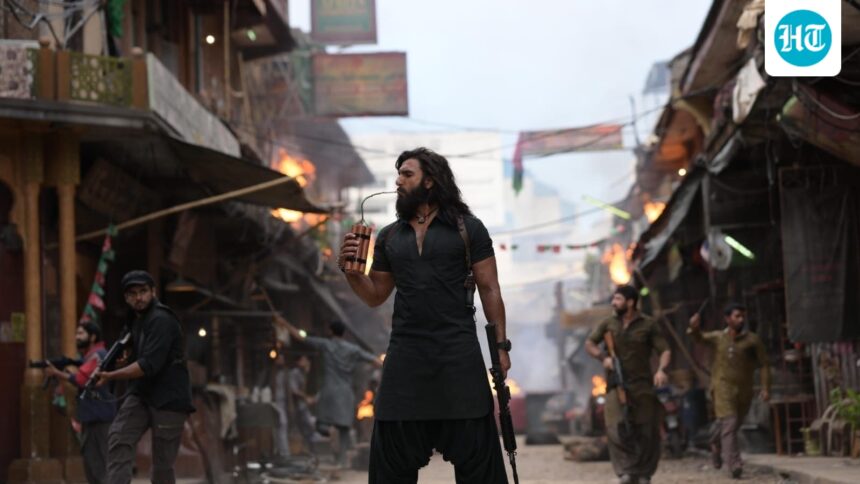
Since the release of its first part in December 2025, ‘Dhurandhar’, directed by Aditya Dhar and starring Ranveer Singh, has broken box office records. Part 2 “Dhurandhar: The Revenge” was released on March 19, 2026; And it just turned up the heat. The images, dialogues and their politics are now being cited in election campaigns and social media battles.
‘Lyari’ posters in Lucknow and Amethi
The latest flashpoint came from Uttar Pradesh. Ahead of the 2027 Vidhan Sabha elections, which the ruling Bharatiya Janata Party hopes to continue its rule, posters inspired by the film have appeared in parts of Lucknow and Amethi, targeting opposition leader Akhilesh Yadav of the Samajwadi Party.
“Aap ko kya chahiya? Akhilesh ka lyari raj,” Says the slogan On these posters, asking if people want chaos. Yogi Adityanath is called ‘Dhurandhar CM’. The word “dhurandhar” basically translates to “supporter”.
The Pakistani reference, Lyari, is a Karachi neighborhood notorious for gang violence, and a prime location in Durandar.
The billboards, which were reported at multiple intersections in Lucknow and outside Amethi railway station, were put up by a group calling itself Youth Against Mafia. The names and photos of the organization’s officials are also displayed on it.
the But the Samajwadi Party hit back. Rajesh Mishra, the party’s spokesman in Amethi, said the posters reflected the “frustration and despair” felt by the ruling Bharatiya Janata Party. “Such tactics are being used because the BJP has realized that it will not return to power,” he said, claiming that the public is “aware of these attempts at misinformation.”
Amethi police station in-charge Ravi Singh confirmed that the authorities had received information about the posters and a team had been sent to the spots.
Prime Minister Modi joins the fray
The film reached the pinnacle of Indian politics, too, two days ago, when Prime Minister Narendra Modi, at a public meeting in Thiruvalla, Kerala, cited “Dhurandhar” along with some previous controversial films to accuse the Congress and the Left of “usual betrayal.”
“Congress, UDF and LDF have developed the habit of lying about everything,” he said. “When we introduced the CAA – (the Citizenship Amendment Act that sparked protests in 2019-20 over alleged discrimination against Muslims) – they spread a lot of lies; today, The Civil Aviation Law has been implemented, and the country has not suffered any harm. When ‘Kerala Files’ came out, they started saying ‘it’s all lies’. When the “Kashmir Files” came out, they started saying “they are all lies”. When ‘Dhurandhar’ was released, they again said it was based on lies.
Himanta brings her to Assam
In Assam, Cm BJP’s Himanta Biswa Sarma has not apologized for the political reading of the film’s box office success.
“Just look at the number of people who will watch it, it means there are many BJP-RSS members around the world. People will watch it in large numbers. It means those who will watch it,” he said.Dhurandhar will vote for the BJP. It’s good for us.”
It was a frank admission of what critics have long argued, that the film served a political purpose by praising the BJP and the Modi regime even at the cost of distorting facts by usurping artistic freedom.
Congress is attacking the BJP as well as the film and its policies
On the opposition side, Congressman Tariq Anwar launched one of the fiercest attacks on Dhurandhar, and by extension the BJP. “It’s clear that the people who made the film are basically hatemongers,” Anwar said in the week of the sequel’s release. “They took the decade to spread hatred across the country.”
“Through the violence shown in the film, an attempt has been made to create an atmosphere against a particular community. This is the agenda of the BJP. The film has been made to promote this agenda. And those who are doing these things, the BJP and the RSS, are forgetting that this will turn into a big problem for India in the future,” he added.
Raghav Chadha vs AAP
Perhaps the most bizarre use of “Dhurandhar” came not from the BJP or the Congress, but from the Aam Aadmi Party leader – directed at the APC itself.
MP Raghav Chadha, who was removed as the party’s deputy leader in the Senate, issued a video response to the allegations of senior party leaders including Atishi, Saurabh Bharadwaj and Sanjay Singh, who said he was raising “soft issues” and not targeting Prime Minister Modi and the BJP-led NDA on the real issues.
“There is a written campaign against me,” Chadha said. “They are using the same language, the same issues, the same allegations.”
He ends the video with a line lifted directly from “Dhurandhar”: “Gyal hun, isli ghatak hun.” “I am wounded, therefore I am dangerous.” The dialogue also makes references to two Sunny Deol action films.
What’s in Durandar?
And at the heart of all this is the film itself. “Dhurandhar” revolves around an Indian intelligence agent, Hamza Ali Mazari, who infiltrates Karachi’s Lyari neighborhood to dismantle a terrorist network. The film is inspired by true events including the 1999 hijacking of IC-814, the 2001 Parliament attack, and the 2008 Mumbai attacks. It has become the highest-grossing Indian film of 2025. Its sequel has already broken these records.
Critics have noted that the film’s timeline is eclectic. Major events including the Kandahar hijack, the Parliament attack, and the 2025 Pahalgam attack all took place under the BJP-led governments. The covert operation depicted in the film reportedly began during Congress. Critics say the film offers a different impression.
Aditya Dhar objected to the propaganda label. “I honestly feel that the current government does not need a small film like ours to win the elections. They built this film.” “Ram Mandir – something that took 500 years to achieve – so I don’t think they are counting on us for votes.” Regarding his intention, he said that the film was produced “for a national purpose.” “The public is smart enough not to fall for such allegations,” he said.
And on Tuesday, cricket entered the fray too, complementing India’s troika obsessed with politics and cinema, when Team India star Virat Kohli lavished praise on “Dhurandhar: The Revenge”.
He said on Instagram: “I dare say I have never seen a cinematic experience like this made in India. You brought all kinds of emotions to the surface and did not flinch once for almost 4 hours… Aditya Dhar Your talent and conviction are reflected in what you have created. I congratulate you for that. You are a genius.”
Dhar responded with “Woooowww!”, writing, “Watching a legend show love like this once in a generation feels so different.”
He mentioned Kohli’s impact beyond cricket: “The way she carries the country every time she steps out inspires us, in our small way, we will try to make India proud with our film Jai Hind. “

Arish Chhabra is an associate editor on the Hindustan Times online team, where he writes news reports and explanatory features, as well as overseeing the site’s coverage. His career spans nearly two decades across India’s most respected newsrooms in print, digital and broadcast. He has reported, written, and edited across formats—from breaking news and live election coverage, to analytical long-reads and cultural commentary—building a body of work that reflects editorial rigor and a deep curiosity about the community for which he writes. Areesh studied English Literature, Sociology and History along with Journalism at Punjab University in Chandigarh, and began his career in that city, eventually moving to Delhi. He is also the author of Little Big City: What Life is Like from Chandigarh, a collection of critical essays originally published as a weekly column in the Hindustan Times, which examines the culture and politics of a city that is much more than just its famous architecture – and in doing so, holds up a mirror to modern India. During his stints at BBC, The Indian Express, NDTV and Jagran New Media, he has worked across formats and languages; Mainly English, as well as Hindi and Punjabi. He was part of the crack team for the BBC Explainer project which was replicated around the world by the broadcaster. At Jagran, he developed editorial guides and trained journalists on integrity and quality content. He has also worked at the intersection of journalism and education. At the Indian School of Business (ISB) in Hyderabad, he developed a website to streamline academic research in management. At Bennett University’s Times School of Media in Noida, he taught students the craft of digital journalism: from newsgathering and writing to social media strategy and video storytelling. Having moved from small town to larger town to megalopolis for education and work, his intellectual passions lie at the intersection of society, politics, and popular culture—a perspective that guides his writing and worldview. When he’s not working, he’s constantly reading long-form journalism or watching cerebral content, sometimes both at the same time.Read more