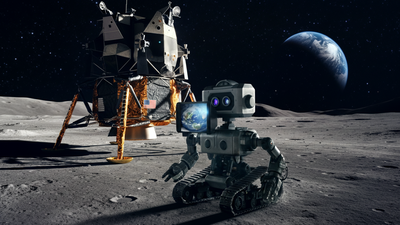
A tiny robot no bigger than a baseball has quietly rewritten the rules of lunar exploration. In January 2024, the Japanese space agency JAXA successfully deployed a transforming rover named SORA-Q on the moon’s surface, transforming from a closed sphere into a two-wheeled vehicle and rolling through the regolith on its own.
SORA-Q was designed with the help of toy company Takara-TOMY, the same company that owns the Transformers brand, and used real transformation engineering rather than movie magic. He walked around the SLIM lander, took color images, then sent them home via an accompanying hopping robot. The mission demonstrated that miniature, autonomous machines can conduct meaningful scientific research even in places that larger, more expensive rovers cannot reach, opening a new chapter in lunar exploration.
What is SORA-Q: Japan’s transforming lunar robot
SORA-Q, officially called Lunar Excursion Vehicle 2 (LEV-2), weighs about 250 grams and is about 8 centimeters across, no bigger than a baseball. Jointly designed by JAXA, Sony, Doshisha University and toy manufacturer Takara-TOMY, the robot begins its journey folded into a closed ball, protecting its electronics during the rough landing. Once safely on the lunar surface, SORA-Q unfolds, dividing its outer shell into two hemispherical wheels while a small camera flips up between them and a tail unfolds back to keep the rover balanced.
According to JAXA’s official mission report, SORA-Q has become the world’s first rover to conduct fully autonomous exploration of the lunar surface, navigating without turn-by-turn commands from mission control on Earth.
Inside JAXA’s SLIM mission that carried SORA-Q to the Moon
SORA-Q’s journey to the Moon took place aboard Japan’s Lunar Exploration Agency’s Intelligent Lander, known as SLIM, which lifted off in September 2023 and touched down on the lunar surface on January 19, 2024. The landing made Japan only the fifth country to achieve a soft landing on the Moon, and SLIM is widely remembered for its pinpoint accuracy, coming to rest near Shiuli crater within the larger Cerrelus crater. In the Mari Nectaris area.
Moments before SLIM reached the surface, SORA-Q launched with another small robot called LEV-1, a jumping device designed to relay communications back to Earth. Technical details of the deployment sequence and broader autonomous robotics goals for the project are documented on the Japan Aerospace Exploration Agency’s Innovation Center for Space Exploration page.
How Takara-TOMY transformer technology shaped the SORA-Q design
The most bizarre part of SORA-Q’s story is its origin. Takara-TOMY, the Japanese toy company that owns the Transformers franchise alongside Hasbro, has brought decades of experience building toys that transform from one form to another.
Engineers adapted the same transformation logic, lightweight folding mechanisms, compact hinges, and shape-shifting joints, for a robot that had to survive launch, the vacuum of space, and abrasive lunar dust known as regolith.
Instead of traditional wheels, the SORA-Q’s design uses curved halves of its spherical body, a technique that helps it push through loose, fine-grained soil rather than digging into it.
This combination of consumer robotics and space engineering allowed the Japan Aerospace Exploration Agency to build SORA-Q at a lower cost and much more quickly than a traditional planetary rover, while still meeting the reliability standards necessary for a true lunar mission.
How SORA-Q autonomously explored the moon’s surface
Once unfolded, SORA-Q used its onboard camera to study the location of the SLIM lander and its surroundings, then plotted its own path around it, identifying obstacles such as small craters and loose rocks without any real-time guidance from Earth.
This kind of autonomy is necessary for a robot of this size, since the distance between Earth and the Moon makes direct remote control practically impossible. SORA-Q took color images of both SLIM and the surrounding terrain, and sent the data to LEV-1, which transmitted it to mission control.
Communication from both robots stopped after about 100 minutes, slightly less than SORA-Q’s expected operating window, a deficiency that the mission team linked to possible damage from LEV-1’s jumping motion or simple battery drain. The full results of the mission, including the full motion sequence and autonomous control data, were later published in the peer-reviewed journal Science Robotics.
Why is the SORA-Q lunar mission important for future lunar exploration?
SORA-Q’s short and successful lunar mission is being treated as a proof of concept rather than a one-time curiosity. The Japan Aerospace Exploration Agency research team, led by Daiichi Hirano, noted in their published findings that small rovers like SORA-Q, despite their limited individual capabilities, show real promise as autonomous explorers capable of reaching places that a single large spacecraft cannot. This idea points to future missions using fleets of low-cost, palm-sized robots that work side-by-side rather than relying on a single expensive vehicle to do everything.
For space agencies racing to study the moon before a manned Artemis landing, SORA-Q’s combination of toy industry engineering and space robotics offers a cheaper and faster way to collect data from hard-to-reach corners of the moon’s surface, and a glimpse of how miniaturized machines could shape the next era of lunar exploration.