

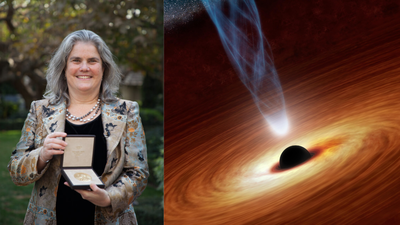
Image: left/Nobel Prize Foundation/right/Canva
Andrea Ghez was always fascinated by mathematics, logic puzzles, and the thrill of solving difficult problems while growing up in Chicago. What started as a curiosity about how things work eventually led her to ask one of the biggest questions in astronomy: What lies at the center of our galaxy? Little is known that decades later, her pioneering observations would provide some of the strongest evidence yet for the existence of a supermassive black hole at the heart of the Milky Way.
In 2020, Ghez became one of the recipients of the Nobel Prize in Physics for her revolutionary work tracking stars orbiting an invisible but extremely massive object known as Sagittarius A*. Her journey from puzzle-loving schoolgirl to one of the world’s most influential astronomers shows how perseverance, curiosity, and scientific rigor can transform our understanding of the universe.
The scientific achievement that revealed a massive black hole in the Milky Way Galaxy
Andrea Ghez, a professor of physics and astronomy at the University of California, Los Angeles (UCLA), has spent more than two decades studying the crowded region surrounding Sagittarius A*, the compact radio source located at the center of the Milky Way.Using powerful telescopes at the W.M. Keck Observatory in Hawaii and advanced adaptive optics technology, Ghez and her team tracked the motions of individual stars orbiting an unseen object. Their measurements showed that these stars were moving at extraordinary speeds under the influence of an enormous gravitational force.The Nobel Committee stated:“The discoveries of one of the heaviest and most exotic objects known, a supermassive black hole, are the result of the pioneering work of the laureates.”
By observing stellar orbits over many years, Ghez demonstrated that about four million times the mass of the Sun is concentrated in a remarkably small region of space. The most convincing explanation is the presence of a supermassive black hole.In an interview with the Nobel Prize Organization:“Andrea Ghes and Reinhard Genzel led a group of astronomers who have focused since the early 1990s on a region called Sagittarius A* in the center of our galaxy.”“As a scientist, make sure students become critical thinkers,” Ghez says. Their observations turned a long-standing theoretical possibility into convincing observational evidence.
Andrea Ghez’s Nobel Prize journey and her message to future scientists
In 2020, Andrea Ghes shared the Nobel Prize in Physics with Reinhard Genzel, while the other half was awarded to Roger Penrose for his theoretical work showing that black holes are a direct consequence of Einstein’s general theory of relativity.Reflecting on her scientific journey, Ghez often highlights the importance of curiosity and perseverance. She said in her Nobel Prize interview:“I learned that you can do anything you want.”She also spoke frankly about overcoming barriers in a field historically dominated by men, and encouraged young people, especially girls, to pursue careers in science and mathematics.In her Nobel Prize lecture, Ghez explained that the quest to understand the center of the galaxy requires scientists to push technological boundaries, develop new methods to see distortions of the Earth’s atmosphere and achieve unprecedented resolution.Today, her work continues to influence modern astrophysics, helping researchers investigate black holes, the formation of galaxies, and the fundamental laws that govern the universe. What began with a childhood love of mysteries eventually led to one of the most important astronomical discoveries of modern times.
Why did Andrea Ghez’s discovery change our understanding of the universe?
The importance of Ghez’s work extends far beyond the Milky Way. Supermassive black holes are now believed to exist at the centers of most large galaxies, influencing their growth, structure and evolution.By proving that an invisible object of enormous mass occupies the center of our galaxy, Ghez helped establish black holes as central components of cosmic geometry rather than theoretical curiosities.As the Nobel Prize Organization notes:“A supermassive black hole is the only currently known explanation.”Her research continues to serve as a foundation for new discoveries, inspiring future generations to explore some of the deepest secrets of the universe.