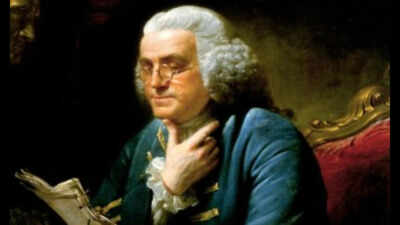
Today’s quote by Benjamin Franklin.
A statement made by Benjamin Franklin on a particular issue has become a memorable quote over the years. America’s Founding Father wrote a letter on behalf of the Pennsylvania Assembly to the governor of the colony in 1755.
It was meant to be an economic and political statement about tax sovereignty. During the French and Indian War, the Pennsylvania Assembly wanted to tax the massive land holdings of the colony’s owners (the Pennsylvania family) to fund frontier defense. The Penn family offered to pay a small lump sum for the defence, on the condition that the Assembly agreed to waive its right to tax their lands in the future.The association rejected the offer. In Franklin’s eyes, accepting a temporary handout (“a little temporary security”) in exchange for giving up the legislature’s fundamental constitutional right to pass tax legislation (“fundamental liberty”) was a dangerous trade.
books: “Those who give up essential liberty, in order to buy a little temporary security, deserve neither liberty nor security.”But this quote has become a memorable statement about the danger of trading basic rights for short-term convenience.The quote suggests that if you give up basic freedoms just because you’re afraid, the “security” you get in return will be fragile and false. A system powerful enough to take away your freedom will eventually use that power against you, leaving you free and unprotected.
Absolute safety is impossible without complete authoritarian control. To live in a truly free society, citizens must accept a certain amount of vulnerability. You can’t build a completely risk-free world without building a cage.People rarely give up their rights when they are calm; They do this when they feel panicked. The quote serves as a warning against allowing immediate crises or fear to drive permanent structural changes in society.
Freedom versus control
Franklin’s quote talks about the choice between freedom and control. It reminds us that fear makes people vulnerable to bad deals. When people feel afraid, they are often willing to surrender their basic rights to anyone who promises to protect them. But absolute safety is impossible to achieve, and control given during a crisis usually remains long after the danger has passed. This quote serves as a constant reminder that compromising basic human rights in exchange for short-term convenience usually leaves a society with less freedom and ultimately no real protection.
Who was Benjamin Franklin?
Benjamin Franklin (1706-1790) was one of the most prominent polymaths in history—a true polymath who excelled as a writer, inventor, scientist, diplomat, and statesman. He is celebrated as one of the major founding fathers of the United States. He was the only Founding Father to sign the four major founding documents: the Declaration of Independence (1776), the Treaty of Alliance with France (1778), the Treaty of Paris that ended the Revolutionary War (1783), and the Constitution of the United States (1787).Franklin was world famous for his scientific experiments long before he entered revolutionary politics. His famous kite-and-key experiment proved that lightning is a form of electricity. He coined common electrical terms still in use today, including battery, charge, positive, and negative. Despite his enormous influence on the creation of the presidency and government, Franklin was never President of the United States.
However, his face has adorned the $100 bill since 1914.