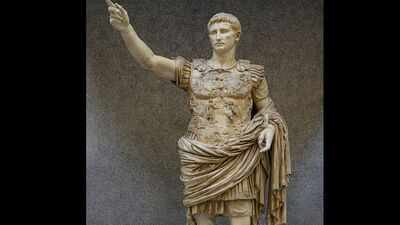
Augustus Caesar (Image: Wikipedia)
Rome’s first emperor spent decades wielding more power than almost anyone else in the ancient world, and on his deathbed, he did not ask to be remembered as a conqueror. Augustus asked his assembled friends whether he had mastered his part in the comedy of life, and then recited a concluding line borrowed from a Greek play.
“Since I played my part so well, all of you clap your hands and send me off the stage with applause.” He was not humble by accident. It was, by most accounts, exactly the kind of carefully orchestrated final impression that he had spent his whole life building, delivered before an audience for the last time, as was the case with almost everything else in his public career.
Today’s quote is from Augustus Caesar
“Did I do my part well in the comedy of life? If so, clap your hands and take me off the stage with applause.”
What is the meaning behind the quote
Augustus portrays life as a show, where everyone plays a role, plays it, and then eventually walks out when it’s over.
His opening question, whether he has played his part well, is not about wealth or conquest. It is about whether he has actually fulfilled the responsibility assigned to him.The applause he demands symbolizes something closer to respect than fame. It’s the approval that comes from faithfully playing the role, not the hype that follows brute force. When asked at the end of a long, eventful life, it feels less like a boast and more like a real final check.
A borrowed line, presented with real theatre
The line that Augustus followed was not entirely his own. According to the Roman historian Suetonius, whose Life of Augustus records the scene in detail, he was quoting the closing lines of a Greek comedy by the playwright Menander. He said this to his friends gathered at his villa in Nola, near Naples, on the 19th of August 14 AD, at the age of seventy-five, after asking if there had been any disturbance in the streets on his account and combing his hair for the last time.His actual last words came moments later, separately, addressed to his wife Livia as he kissed her: “Live mindful of our marriage, Livia, farewell.” The theatrical line about the comedy of life came first, delivered to an audience of friends, in a scene that seemed less like an accident and more like the performance he had been rehearsing throughout his public life.
Why does Augustus’s private life make the quote different?
Born Gaius Octavius, Augustus became Julius Caesar’s adopted heir before surviving years of brutal political conflict to become the first emperor of Rome in 27 BC.
His reign rebuilt the Roman government, financed major infrastructure, and ushered in the Pax Romana, a long period of relative peace after decades of civil war.None of that appeared in his last mentioned words. Rather than citing military victories or political reform, he framed his entire life as a role to be judged on how well he carried it out. This framing comes from one of the most powerful rulers in history, and carries more weight than it would from someone with much less to boast about.
Everyone plays some role, no matter how big
Not everyone rules an empire, but everyone occupies some role: parent, teacher, neighbor, colleague. The August metaphor does not require a large stage to apply. He wonders whether the part, no matter how large, was executed with real care.A loyal teacher or honest neighbor can leave a legacy as meaningful in his own sphere as an emperor can leave in his own. The metaphor is easily pared down because it was never about the size of the role in the first place.
Other famous quotes attributed to Augustus
- “Hurry up slowly.”
- “I found Rome a city of brick and left it a city of marble.”
- “Whatever is done well enough is done quickly enough.”
- “Young people, listen to a sheikh who was listened to by sheikhs when he was young.”
Why this still resonates today
Modern success is usually measured by wealth, titles, or visible achievement. Augustus, at the end of his actual life, measured his life instead by whether he had played his part faithfully. The titles fade out and the applause eventually stops. What remains to be seen is whether the role, no matter how big or small, was carried out in the way it deserved.