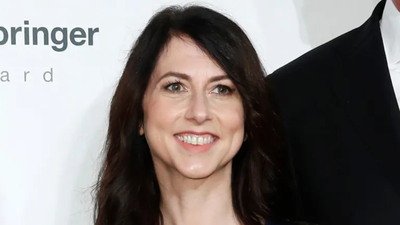
MacKenzie Scott has spent the past several years doing something that few billionaires have attempted on this scale: giving away massive amounts of wealth as quickly as possible. This approach has now earned the Amazon co-founder and ex-wife of Jeff Bezos a place on Forbes’ Iconoclast 50 list, which honors people who are reshaping industries and challenging conventional thinking.
According to Forbes, Scott has given away an estimated $26.4 billion in less than seven years, including nearly $7.2 billion in 2025 alone. The figure represents the largest annual charitable contribution by an individual since Forbes began tracking philanthropy in 2012, cementing Scott’s reputation as one of the most influential philanthropists of modern times.
Forbes honored MacKenzie Scott’s $26.4 billion in donations
The Forbes Iconoclast 50 is an annual list that celebrates individuals who challenge established systems and innovate new ways of thinking.
Honorees come from a wide range of fields, including business, technology, science, culture and philanthropy.Rather than focusing solely on financial success, the list highlights people whose ideas and actions have changed the way organizations operate. Scott’s inclusion reflects a growing recognition that her approach to philanthropy has changed expectations about how the wealthy distribute their wealth.
Unlike many major donors, Scott rarely sets detailed conditions for her contributions. Instead, they often offer unrestricted grants, allowing organizations to determine how the funds can best serve their needs.This trust-based model has attracted attention throughout the philanthropic world. Traditional donations often come with extensive reporting requirements and strict spending rules. Scott’s philosophy is different.
Its approach assumes that people closest to the problem are usually in a better position to solve it.This strategy has allowed beneficiary organizations to move quickly, expand programs and invest in long-term goals without exceeding complex restrictions imposed by donors.
HBCUs have benefited greatly
Among the biggest beneficiaries of Scott’s philanthropy have been historically black colleges and universities (HBCUs), institutions that have long played a critical role in American higher education despite decades of chronic underfunding.Scott’s donations to HBCUs have surpassed the $1 billion mark through direct gifts and related initiatives. Institutions including Howard University, Prairie View A&M University, Morgan State University, Spelman College, Virginia State University and Winston-Salem State University have received significant support.For many of these universities, unrestricted funding provides something that is often difficult to obtain: flexibility.
Leaders can allocate resources to scholarships, faculty hiring, research programs, student services, infrastructure improvements, or endowment growth based on their most pressing needs.
Donations make headlines
Some of Scott’s biggest recent gifts have attracted national attention.Howard University received an unrestricted donation of $80 million in 2025, one of the largest gifts in the institution’s history. Prairie View A&M University received $63 million, bringing Scott’s total contributions to the Texas-based HBCU to $113 million after a previous donation of $50 million in 2020.Such gifts can have impacts beyond annual budgets. Large, unrestricted donations can promote financial stability, support future generations of students, and provide institutions with the resources needed to achieve ambitious academic and research goals.
A new model for billionaire philanthropy
Scott’s rapid pace of giving has sparked debate among economists, higher education experts and philanthropy scholars.Many large fortunes are gradually distributed through institutions over decades.
Scott has chosen a different path, moving billions of dollars to communities and organizations in a relatively short period. Proponents argue that urgent challenges require urgent responses and that resources can have greater impact when deployed sooner rather than later.Her model has also revived the debate on trust-based philanthropy, a growing movement that emphasizes reducing barriers between donors and recipients while increasing institutional independence.
Beyond Amazon Wealth
Although Scott’s fortune largely arose from her early stake in Amazon, her overall legacy has increasingly come to be defined by what she did with that wealth rather than how she accumulated it.For Black college campuses and thousands of other organizations in education, health care, housing, and community development, Scott’s contributions opened up opportunities that would have taken years to secure.Therefore, its estimate by Forbes exceeds the total amount donated. It reflects the impact of a philanthropy model that prioritizes speed, trust, and institutional empowerment. In an industry often criticized for moving slowly, Mackenzie Scott has proven that giving at scale can work differently, and it’s precisely that difference that has earned her a place among Forbes’ Most Influential Changemakers.