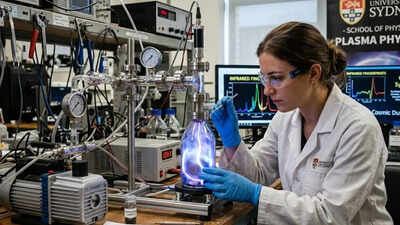
A pioneering study conducted by Linda Losurdo, a PhD student at the University of Sydney, has successfully simulated the harsh chemical environments of space in the laboratory. By combining nitrogen, carbon dioxide and acetylene in a high-voltage electric plasma, she recreated part of the universe inside a bottle in her laboratory, creating cosmic dust from scratch.
The results were published in the Astrophysical Journal. This research provides a completely new way to reverse engineer the chemical history of celestial bodies. Scientists can use this process to examine infrared spectral fingerprints to determine the chemical pathways that led to the synthesis of complex organic molecules, the building blocks of life, before life appeared on Earth.
Scientists have replicated the birth of cosmic dust
Researchers experimented with this at the University of Sydney’s Plasma Physics Laboratory. In the experiment, the team, consisting of Ms Losurdo and her supervisor Professor David McKenzie, used a vacuum pump to evacuate air from glass tubes, recreating the near-empty conditions of space. Then nitrogen, carbon dioxide and acetylene were introduced. The gas mixture was exposed to about 10,000 volts of electrical potential for about an hour, creating a type of plasma known as a glow discharge.
New laboratory analysis methods allow researchers to measure the influence of ions and the temperature and pressure conditions that create dust in stellar nebulae, which may help scientists better understand the chemical composition of asteroids and meteorite materials by providing a new way to interpret chemical signatures found in asteroids and meteorites.
Did the necessities of life arrive from space?
Researchers have created isotopes that consist of certain elements (carbon dioxide, acetylene, and nitrogen) that when combined form what is known as CHON (carbon, hydrogen, oxygen, and nitrogen).
CHON is very important in the production of organic compounds, and is thought to have been brought to Earth by comet and asteroid collisions billions of years ago. By determining how CHON formed under high-energy conditions (such as during a supernova), scientists will determine whether the building blocks of life formed in space before being brought to Earth. This research gives scientists an experimental framework to test these hypotheses about the origins of life and will not require waiting for exotic materials to return to Earth.
How laboratory data will enhance astronomical observations
The ultimate goal behind this project is to build a large-scale database of infrared spectroscopic signatures developed through laboratory production of cosmic particles or cosmic dust. Nowadays, scientists identify materials in space by measuring the infrared emissions associated with those materials; Therefore, the project must establish a source of “molecular fingerprints” (i.e. a reference set) of materials produced under specific laboratory conditions.
Once complete, this resource should help astronomers perform more accurate, well-supported identifications and analyzes of candidate sources of interest in outer space (e.g., stellar nurseries and remnants of dead stars). This will improve our knowledge of the various chemical and physical processes that influenced the evolution of our Milky Way Galaxy.