

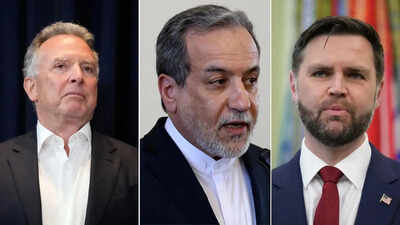
US President Donald Trump will send top envoys Steve Witkoff and Jared Kushner to Pakistan this weekend for crucial talks with Iranian Foreign Minister Abbas Araqchi, the White House said on Friday, in a renewed effort to revive negotiations amid rising regional tensions.White House press secretary Carolyn Leavitt said the administration is cautiously optimistic. “We hope it will be a productive conversation and we hope we can move the ball forward toward an agreement,” Levitt said in an interview on Fox News.Vice President J.D. Vance will not travel for the time being but remains “deeply engaged” in the process, she said. She added that he will remain in the United States along with Secretary of State Marco Rubio and the national security team, “ready” to travel to Pakistan “if necessary.”Vance does not plan to attend at this point because Iranian Parliament Speaker Mohammad Bagher Qalibaf will not participate either. The White House considers Ghalibaf to be the head of the Iranian delegation and Vance’s counterpart, CNN reported, citing officials.Meanwhile, Jared Kushner and Steve Witkoff have been in talks with Iranian officials for months, to work on reaching a possible agreement on Tehran’s nuclear program.
The diplomatic initiative underscores the growing role played by Pakistan as a mediator. Islamabad is trying hard to bring Washington and Tehran back to the negotiating table after the talks failed to resume earlier this week as expected.Earlier in the day, the state-run Islamic Republic News Agency (IRNA) also confirmed that Araqchi is heading to Pakistan as part of a broader diplomatic tour that also includes Oman and Russia.
The Iranian foreign minister said on social media that his trip would focus on “bilateral issues and regional developments.”Pakistan’s efforts come after Trump agreed to extend the ceasefire with Iran indefinitely, a move said to have been taken at Islamabad’s request to allow more time for diplomacy.Despite these diplomatic initiatives, the situation on the ground remains volatile. The ongoing conflict has severely affected traffic through the Strait of Hormuz, a vital artery through which nearly a fifth of the world’s oil and natural gas passes during peacetime.The recent Iranian attacks on commercial ships and the ongoing US blockade of Iranian ports have increased tensions in the region. Trump ordered US forces to take a tough stance, including directing the military to “shoot and kill” small boats suspected of laying mines.Earlier, US Defense Secretary Pete Hegseth reiterated Washington’s position, saying: “Iran faces an important choice, and an opportunity to make a deal, a good deal, a wise deal.” He also added that a second US aircraft carrier would join the blockade in a few days, adding to an already massive deployment that includes the USS George H.W. Bush, the USS Abraham Lincoln, and the USS Gerald R. Ford.According to US Central Command, the deployment now includes about 200 aircraft and 15,000 soldiers, marking the first time since 2003 that three US aircraft carriers have operated simultaneously in the region.The talks are seen as a crucial attempt to revive stalled negotiations over Tehran’s nuclear program and ease tensions that have rocked global markets. The price of Brent crude, the international standard, ranged between $103 and $107 per barrel, more than 50% higher than levels recorded before the conflict began in late February.In response to the supply crunch, the White House on Friday announced a 90-day extension of the Jones Act waiver, allowing non-US ships to more freely transport oil and natural gas to US ports.The extension, approved by Trump, builds on a previous 60-day waiver introduced in March to stabilize energy prices and ease shipments after disruptions caused by the virtual closure of the Strait of Hormuz.