

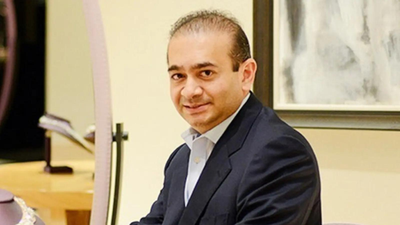
LONDON: Fugitive jeweler Nirav Modi has applied to the European Court of Human Rights (ECtHR) in France seeking an injunction to prevent his extradition to India.A DPP spokesperson told TOI: “Nirav Modi is scheduled to be removed from office, but he has filed a Rule 39 application to stay his extradition to the European Court of Human Rights.
“We are not involved in that.”Nirav’s application to reopen his original appeal against his extradition was rejected on March 25 by the High Court in London, leaving the 55-year-old, accused of defrauding Punjab National Bank of more than $1 billion, with nowhere to turn in Britain, and Strasbourg his only option. The CBI can take him out of the UK within 28 days of March 25, but he cannot return now while Rule 39 proceedings are under consideration.Extradition lawyer Ben Keith, of 5 St Andrews Hill, told TOI: “There is no hearing. It is all done in writing. The matter will go to an ECtHR judge who will usually make a decision within 48 hours. They may ask the UK government for more information, in which case it may take longer. There is no time limit. The UK government will not remove it while an ECHR judge considers an application under Rule 39. They are rarely successful. You make a written application.” For a ruling in which you say that your client faces an imminent risk of irreparable harm and has exhausted all domestic remedies, the ECtHR judge will then consider the case and make a decision.
“Most Rule 39 requests were denied. In 2025, out of 2,701 requests, only 222 were approved.Interim measures under Rule 39 do not determine the outcome of the case – they only seek to prevent irreparable harm from occurring while the case is pending.If an injunction is granted under Rule 39, the extradition will be halted and it will proceed to a main hearing where both sides present their full arguments and a panel of judges decide whether a human rights violation has occurred.“It can take three to five years to get done…there are rarely in-person hearings,” Keith said.