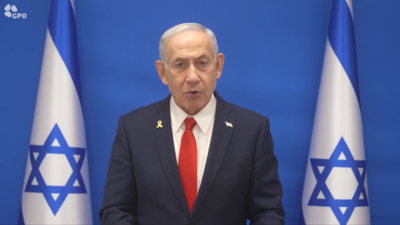
Israeli Prime Minister Benjamin Netanyahu said on Friday that Israel will maintain its military presence in southern Lebanon until Hezbollah is completely disarmed, even as Israel, Lebanon and the United States signed a tripartite framework aimed at ending decades of conflict and laying the foundation for a broader peace agreement.“The most important thing, first and foremost, is that Israel remains in the security zone in southern Lebanon,” Netanyahu said in a recorded video released shortly after the agreement was signed in Washington. “This is a major achievement, and we will maintain it as long as Hezbollah does not disarm.”This framework commits Israel and Lebanon to a phased process whereby the Lebanese Armed Forces will gradually assume control of Lebanese territory after the disarmament of Hezbollah and other non-state armed groups.
In return, the IDF will gradually redeploy from Lebanese territory through a series of agreed-upon pilot areas.Speaking after the signing ceremony, US Secretary of State Marco Rubio described the agreement as the beginning of a longer peace process.“Today is the beginning of the beginning,” Rubio said. “We have a lot of work ahead of us. We in no way underestimate the difficulty of the task ahead of us.
But we realize its importance, and how important it is. We are honored to play a role in bringing this together.”Netanyahu said Israel would begin implementing two pilot zones under the agreement, allowing the Lebanese army to control territory that the Israeli army no longer considers strategically necessary.He added, “We are implementing two experimental areas based on the army’s recommendation. One is completely outside the security zone and south of the Litani River, and the other is north of the Litani.”The tripartite framework does not specify the two sites. It states that two initial pilot areas have been agreed between the IDF and the Lebanese Armed Forces, where gradual and verifiable redeployments of Israeli forces will take place once it is confirmed that non-state armed groups have been disarmed and their infrastructure has been dismantled.Netanyahu said that the withdrawals would not change Israel’s overall security situation in southern Lebanon and ruled out the return of displaced Lebanese civilians to the security zone currently controlled by Israel.“We maintain the original security zone at all times, outside the range of anti-tank fire. We do not allow Hezbollah to enter it, and we do not allow the civilian population to enter it,” he said.The framework signed by Israel, Lebanon and the United States sets out a mutual, condition-based road map aimed at ending hostilities. It requires Lebanon to restore state authority over its territory, monopolize the use of force, and ensure the complete and verifiable disarmament of all non-state armed groups, especially Hezbollah.In return, Israel committed to gradually redeploying its forces from Lebanese territory once the agreed-upon security conditions were met. The agreement also stipulates that Israel has no territorial ambitions in Lebanon and that eliminating the threats posed by Hezbollah would eliminate the need for any future Israeli military presence.The framework also stipulates the establishment of a military coordination group with the participation of the United States, reconstruction with international support in areas transferred to Lebanese control, and the launch of direct negotiations towards a comprehensive peace and security agreement.Lebanon’s Ambassador to the United States, Nada Hamada Moawad, described the agreement as “a first step on the path to restoring Lebanon’s sovereignty and territorial integrity.”Lebanese President Joseph Aoun thanked the Trump administration for hosting the negotiations, saying that the agreement would allow the Lebanese people “to return to their completely liberated land… under the sovereignty of a Lebanese state that has no partner in its sovereignty over its land and its people.”But Hezbollah refused negotiations. Hassan Fadlallah, a member of the Lebanese Parliament for Hezbollah, criticized the talks and urged the Lebanese government to abandon them.Fadlallah said in an interview with the pro-Hezbollah Al-Mayadeen news channel: “Whoever shakes hands with the enemy is a criminal like them.”The agreement comes after five rounds of US-brokered negotiations in Washington, after months of fighting between Israel and Hezbollah.
Previous ceasefire efforts, including the truce announced in April, have failed to stop the conflict.Under this framework, the United States also pledged to mobilize international support for Lebanon’s reconstruction, economic recovery, and humanitarian assistance, while future U.S. assistance to the Lebanese Army will be linked to verified progress in disarming non-state armed groups and restoring full state control throughout the country.