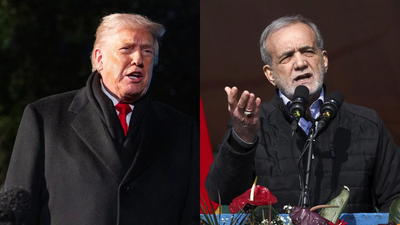
Iranian President Masoud Pezeshkian said on Sunday that his statements regarding attacks affecting Gulf states were “misinterpreted by the enemy,” after his comments were widely seen as a signal of a possible suspension of strikes on neighboring countries.Speaking to state television, Pezeshkian said that Iran seeks good relations with countries in the region and has no intention of creating divisions with its neighbors, adding that his statements were “misinterpreted by the enemy who seeks to sow division with neighbors.”
“Take the dream of surrender to the grave”: Iran tears at Trump’s “unconditional” request
Click for live updates“It has been repeatedly said that we are brothers and should have good relations with neighbors,” he said, citing state media. “However, we are forced to respond to attacks, but this does not mean that we have a dispute with a neighboring country or want to disturb its people.”
This clarification came after Pezeshkian’s previous statements, including an apology to neighboring Gulf states affected by Iranian attacks targeting US military facilities in the region, sparked controversy locally and across the region.“I personally apologize to the neighboring countries that were affected by Iran’s actions,” he said earlier, urging them not to join the US-Israeli military campaign against Iran.
The Iranian President had also indicated that the Interim Command Council in Tehran had agreed to stop attacks on neighboring countries unless strikes against Iran were launched from its territory.However, the statement sparked criticism from hardliners inside Iran. A deputy commander in the president’s office later clarified that Iranian forces would continue to “respond firmly” to any attacks launched from American bases in the region.Ali Larijani, secretary of Iran’s Supreme National Security Council, said on state television that there was no disagreement among Iranian leaders over the country’s strategy in the ongoing conflict.Pezeshkian’s latest statements may have been prompted by reactions to comments made by US President Donald Trump. On Saturday, Trump responded to Pezeshkian’s statement by claiming that Iran had in fact apologized and pointed out this apparent weakness.Trump later warned that the United States may expand its goals. “He may have been talking about the oil facilities a few hours ago,” said Izadi, a professor at the University of Tehran, referring to Trump’s comments.“After this video appeared, Trump issued a social statement of truth saying that Iran had apologized, saying this shows they are capitulating,” Izadi said, adding that the response sparked criticism of Pezishkian from political opponents at home.At the same time, Trump indicated that Washington was not inclined to continue negotiations with Tehran as the conflict intensified.Speaking to reporters aboard Air Force One on Saturday, Trump said the ongoing military campaign could make negotiations unnecessary if Iran’s leadership structure collapses. “At some point, I don’t think there will be anyone who will stay, perhaps to say, ‘We give up,'” he said.The conflict has entered its second week with Israeli forces launching new strikes across Iran, including Tehran.
Iranian authorities say the US-Israeli campaign killed at least 1,332 civilians and injured thousands, while Iranian missile and drone attacks killed 10 people in Israel.Iran has also targeted US military facilities and allied countries hosting US forces. Saudi Arabia, Kuwait and the United Arab Emirates reported drone incidents over the weekend, while Iran’s Revolutionary Guard said it struck US forces at a base in Bahrain.The conflict has also spread to Lebanon, where Israel has warned the government that it will face a “very heavy price” if it fails to rein in the Iran-backed Hezbollah group. Reports indicate that Israeli raids on Hezbollah-controlled areas, including the southern suburbs of Beirut, have killed about 300 people since Monday.The escalating war has also destabilized global energy markets, with unrest across the Gulf pushing oil prices to multi-year highs and prompting many regional producers to cut production.