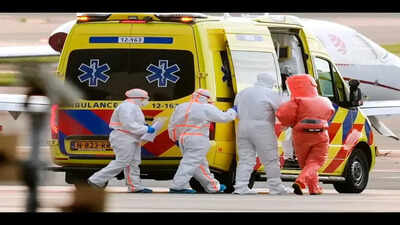
JOHANNESBURG: When South African infectious disease specialist Lucille Bloomberg checked her email on the morning of May 1, as the country celebrated the Labor Day holiday, an urgent message caught her attention.A UK-based colleague, who monitors diseases in remote British Overseas Territories in the South Atlantic, wrote about a cruise ship passenger, sailing thousands of miles in the Atlantic, who was evacuated and admitted to a Johannesburg hospital with suspected pneumonia. Others on the ship were also sick. Bloomberg and other experts at South Africa’s National Institute of Communicable Diseases were suddenly plunged into the race to determine the cause of the outbreak on the Dutch cruise ship MV Hondius.
Despite the holiday, it was “busy,” she says. Within 24 hours, they determined that the man’s illness was caused by Hantavirus, a rare virus transmitted by rodents. But first, Blumberg and her colleagues had to rule out a host of other possible infections before narrowing the search to the original cause. First, they thought it might be Legionella, a bacteria that causes a serious form of pneumonia, bird flu. “Legionella is well described in outbreaks in hotels and on cruise ships, and influenza certainly is.”
Tests on all of these were negative. Experts also performed a wide range of tests for other respiratory diseases.
And also they are all negative.The team then began looking more closely at birdwatchers, reportedly going to parts of South America where there are birds, but also rodents. This has pushed South African disease experts toward another theory: a rare rodent-borne Hantavirus infection, which is found in parts of South America.
“It is a well-described virus, not common, in Chile and Argentina,” Bloomberg said. There was also timely help, as hantavirus experts from South America and the United States, facilitated by the World Health Organization, the United Nations health agency, were just a Zoom call away. “That was very unusual,” she said.By then, it was Saturday morning. Bloomberg contacted the head of the only laboratory in South Africa that can test for Hantavirus. “I said, ‘We want to do Hanta,’ and she said, ‘Yes, I’m coming.'” Tests on the sick man’s blood samples came back positive for Hantavirus that afternoon. The team conducted a second set of tests to confirm this.